

Stageira’s not one of the first rank cities of the ancient Greek world and doesn’t trouble the histories of the period too much, but it did have the lure of a famous name (more on that below…) and turns out to have some pretty interesting archaeology and some great views that certainly repay a visit.
It’s one of a flurry of cities founded, as the story goes, by colonists from the great island of Andros in the Cyclades in the 650s BC, with a few Chalcidians from the long island of Euboea, both east of Athens. A spray of Greek cities was established in the north Aegean in the seventh century, and like some others we can guess that the rich mineral resources of the area were a factor drawing the new city: the north east of the Chalcidice, the three-fingered northern peninsula which is a distinctive marker of the Greek coastline (or Khalkidiki) has silver mines from our period.
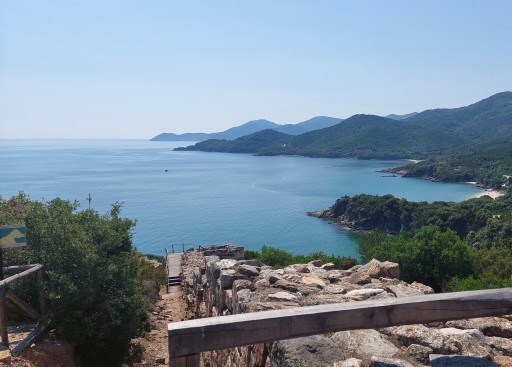
It's a pretty good site for an outpost: the early city was able to occupy a nice safe spot at the end of the hogsbacked peninsula, overlooking some good beaches for drawing up ships. It’s still an attractive place for visitors today, though now usually to swim in the sparkling waters, enjoy a meal on the beach or just take in the fine view of islands and headlands. The city obviously did well for itself: early on, in the sixth century, it walled off the very end of the peninsula, evidently having enough to exercise jealous attention, and was able to throw the walls out far further a century later. Houses spread through the interior as the population grew: though much of the peninsula is now covered with thick vegetation, they’ve been found all across it and quite a few are now visible, terraced into the rising and falling terrain. Thanks to excavations since late last century, you can trace the dining rooms and hearths and the little open-air courtyard where the family would busy itself in a lot of its work.
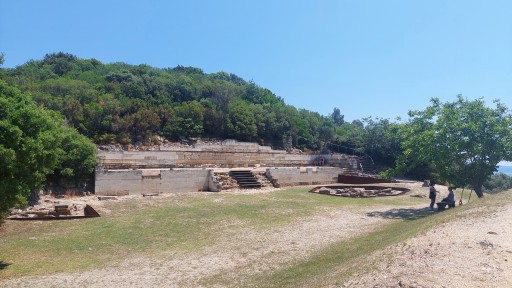
Nor is it just the day-to-day buildings that we find; we have a few shrines, one with several rooms, set evocatively high up on a steep slope over the shore and its dark waters. Another is a sizeable temple, perhaps even a great hekatompedon, a ‘hundred footer’ – a good thirty metres of foundations with carefully cut blocks is still visible on the ground, though we miss the marble decoration which has since found its way museum-ward. Near the centre of the peninsula, we have part of what appears to be the agora, the central place for politics and the market, dominated by the fantastic remains of a beautifully-made stoa, a long building with a shaded colonnade where business, public or private could be done.

The quality of the stonework on this is very high indeed. Add to this the extensive walls of around 500 BC, and we can see that it was a city with pride in itself, and a determination – and a need – to protect what it had. Those walls are pretty impressive and characterful, for even if Stageira was not a massive city, they amount to a sizeable investment, especially with the addition of fortified towers. And why ‘characterful,’ well take a look at the masonry, alternately an unusual style known as ‘Egyptian’ or the intricate polygonal so-called ‘Lesbian’ work, and all in stones of a profusion of colours – particularly all manner of browns, covering practically every hue from the biscuit barrel!


And that would be that, but for the famous connection. For Stageira’s most famous son was absolutely of the first rank in Greek history, and had profound connections with the Macedonian royal house – Aristotle, no less. By this time, Aristotle was of course tutor to Philip’s son, Alexander, and that brought privileges and opportunity. Aristotle, then, was able to obtain the resurrection of his home-city, and it was refounded – though it’s not entirely clear if Philip or Alexander was the final agent. The city was never quite what it had been, but it gained another few centuries of life thanks to its dutiful citizen. In return, if a very late source of the kind we’d normally be a bit wary of is to believed, after his death Aristotle’s body was repatriated to Stageira and a kind of shrine, the Aristoteleion, set up to honour his memory. Recently, it’s been suggested that a structure found near a spot where walls of several periods braid together might even be this very building. More than a few are sceptical, and more work needs to be done, but its an interesting spot in its own right, and at the very least it’s appropriate that the question needs to be teased by argument over the evidence, even if the tingle that you get from potential proximity to such a famed individual’s last resting-place might be verging on … irrational(?)
To visit Stageira with expert guides, join our cultural and archaeological tour of Macedonia.


Leave a Reply