
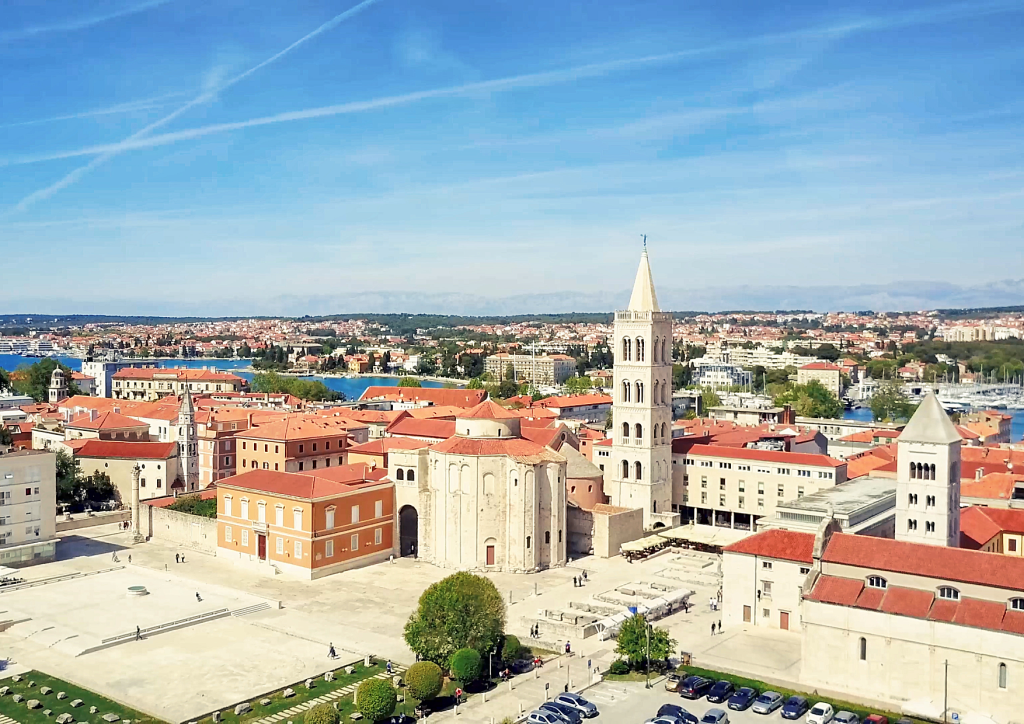
Zadar is one of Croatia’s most captivating coastal cities and a bit of a show-off in the best possible way. It is the second-largest city in Dalmatia after Split, and the capital of northern Dalmatia. For travellers with a soft spot for archaeology and history, Zadar is pure joy!
Modern Zadar stretches well beyond its historic core, but the city’s heart still beats on a compact peninsula that has been in the spotlight for a very long time - close to 3,000 years of history layered into a walkable old town. Today, Zadar blends lively cafés, restaurants and seaside promenades with an unmistakable sense that you are strolling through a living museum.
A LIBURNIAN STRONGHOLD PLUGGED INTO THE PREHISTORIC WORLD
The first known people to inhabit Zadar were the Liburnians, who dwelt in northern Dalmatia during the early Iron Age (c. 900 – 400 c. BC). They did not leave any written records of their own, but were noted by a number of ancient Greek authors. The earliest known mention comes from Hecataeus of Miletus around 500 BC. The Liburnians were famously skilled seafarers. That is not surprising, given their home waters: a dramatically indented coastline ringed by a stunning archipelago. However, they were not only a people of the sea. Inland, across the fertile plains of Ravni Kotari, the Liburnians also thrived as farmers and livestock keepers.
Right on that sweet spot between sea routes and fertile inland regions, a settlement grew into what the Romans would later call Iader. It seems the Liburnians likely used a similar name. Archaeological traces suggest that life on Zadar’s peninsula began in the late Bronze Age or early Iron Age (around the 10th/9th century BC). From this position, the Liburnians could control both the surrounding farmland and a key maritime corridor running through the Zadar Channel.

A lavish Liburnian pectoral (ornamental chest piece) displayed at the Archaeological Museum in Zadar
Ongoing archaeological work in Zadar (especially active since the end of the Second World War) has uncovered material that paints a picture of a strategically connected community. Finds suggest that the Liburnians communicated across the Adriatic, particularly with Picenum (today’s Marche region in Italy), as well as in Daunia and the rest of Apulia, regions located in the south-eastern part of the Apennine Peninsula. From there came luxury pottery: Daunian and South Italian vessels decorated with geometric patterns, prized in the early Iron Age. At the same time, the Liburnians of Iader also imported Greek goods. Among the most valuable pieces is a fragment of a red-figure Athenian kylix – a wide, shallow wine cup - attributed to the painter Aristophanes. One of archaeology’s “hot questions” is how these Greek vessels reached Liburnian hands. Were they traded indirectly via southern Italy, arriving alongside other valuable goods? Or were they sold directly by Greek merchants, especially from Aegina and Athens, who, from the mid-6th century BC, regularly sailed north into the Adriatic, linking into major trading hubs such as Adria and Spina, two multi-ethnic emporia situated in the Po River delta?
Then again… there is another possibility. In antiquity, the Liburnians also had a reputation for piracy - a label that stuck particularly firmly in Roman times. Hence, some of these glamorous imports may have arrived not through regular commerce, but through far less courteous means.

A South-Italian geometric vessel displayed at the Archaeological Museum in Zadar.
IADER: ZADAR’S ROMAN CHAPTER
From the 3rd century BC onward, Roman interest in the eastern Adriatic grew stronger. Unlike some neighbouring peoples, the Liburnians do not seem to have entered into open conflict with Rome, at least not according to the written sources we have. That relative stability likely allowed Iader to develop steadily, and by the Hellenistic period, the city already appears to have had a regular street plan. Scholars still debate exactly when Iader became a Roman colony: possibly under Julius Caesar (49–44 BC), or perhaps under his successor, the first Roman emperor Augustus (27 BC- 14 AD). A particularly valuable inscription preserved in the Archaeological Museum in Zadar reads:
IMP CAESAR DIVI F AUGUSTUS PARENS COLONIAE MURUM TURRIS DEDIT
In other words, Augustus is presented as a “father” of the colony and credited with providing walls and towers. By the 1st century BC and into the Early Imperial era, Iader was thoroughly organised according to classic Roman urban planning: straight longitudinal and transverse streets forming a neat grid, dividing the city into rectangular blocks. This 2000-year-old pattern can still be easily noticed today as you explore Zadar.

A Roman inscription referring to Emperor Augustus as the father of the colony of Iader. Displayed at the Archaeological Museum in Zadar
At the western end of the peninsula sat the Roman Forum, the beating civic heart of the city, with the elevated Capitolium and its temple nearby. Inscriptions tell us that the temple honoured the Capitoline Triad (Jupiter, Juno, and Minerva), suggesting the central cult may have been established as early as the Republican period. Zadar still bears many marks of its Roman past. As you wander, you will spot remnants of grand public buildings, including a monumental column on the western side of the Forum, stylistically dated to the Flavian period (69 – 96 AD), still standing in its original position. In the Middle Ages, it served as a pillory, a literal “column of shame” – a place in a town square where someone convicted of an offense was physically restrained and displayed so everyone could see, mock, or shame them. Nearby, large pilasters from a balustrade display figures of the god Jupiter Ammon and a Gorgon: architectural fragments that once decorated the porticoes surrounding the Forum of Iader. There are also traces of old city gates, Roman defensive walls, and countless smaller details that hint at the city’s former imperial confidence. Even now, researchers are hunting for the “missing pieces”, most notably the likely location of an amphitheatre.

Some pieces of Roman architecture on display in the Forum, with the “Column of Shame” in the far left background.
For anyone interested in Roman history and archaeology, the Archaeological Museum in Zadar is well worth a visit. It offers an excellent window into Roman daily life. The redesigned Roman collection is arranged in thematic “niches” exploring topics ranging from the army and burial customs to roads, cults, and grave goods.
Rich Roman graves across several of Iader’s necropoleis have yielded a remarkable assemblage of glass finds. This archaeological legacy helps explain why modern Zadar is home to the Museum of Ancient Glass, a distinctive institution whose permanent display is arranged across multiple floors. The museum’s galleries introduce visitors to ancient glassmaking technology and to Roman funerary practice, with particular attention to the range of glass urn forms used in burial contexts. The collection also features several less common vessel types and unusual shapes that illustrate the diversity and sophistication of Roman glass production. On the upper level, a dedicated workshop offers the chance to observe traditional glassblowing techniques, providing a clear connection between ancient craftsmanship and its modern revival.
For our tour, the Archaeological Museum and the Museum of Ancient Glass are essential stops in Zadar!

Some of the stunning Roman vessels in the Museum of Ancient Glass
LATE ANTIQUITY AND EARLY MEDIEVAL “DRAMA”
The period of Late Antiquity, shaped by migrations and the arrival of “barbarian” groups (late 4th to 6th century AD), is often seen as a time of gradual stagnation for the city. Alongside deep social, economic, and political pressures, a devastating earthquake struck Zadar in the 6th century. But change also brought new beginnings. As Christianity grew in influence, a new sacred complex emerged in the city centre, including a basilica with a baptistery and other religious buildings. During the 6th century, Zadar came under the rule of the Byzantine Empire and remained within its orbit, becoming an administrative centre of the Byzantine province of Dalmatia.
In the early seventh century, Avars and Slavs moved closer from the Balkan interior, and this broader wave of migration is thought to have brought communities into the region that later sources would identify as Croats. A major cultural and political leap followed in the early 9th century. The most prominent figure of the era was Bishop Donatus, who played a role in the intricate diplomacy between Charlemagne’s Frankish realm and Byzantium.

The church of St. Donatus on top of the Roman forum in Zadar
Tradition credits Donatus with commissioning Zadar’s most recognisable early medieval landmark, the remarkable pre-Romanesque church that still stands on the Forum today. It was originally a rotunda dedicated to the Holy Trinity, but from the fifteenth century onward it became known as the Church of St Donatus. Much of its architectural decoration, including its monolithic columns, is ancient spolia, recycled from the ruined Roman forum. When archaeologists exposed the foundations, they found a whole series of Roman column drums forming part of the base on which the church was built, directly atop the remains of the Forum.
Stylistically, the church of St Donatus is often described as an imaginative fusion of East and West, with scholars frequently pointing to influences such as the Church of San Vitale in Ravenna and Charlemagne’s Palatine Chapel in Aachen. The building made such an impression that the learned Byzantine emperor Constantine VII Porphyrogenitus (913 – 959) mentioned it in his famous work On imperial administration (in Latin De administrando imperio), and also recorded an intriguing medieval name for the city – Diadora.
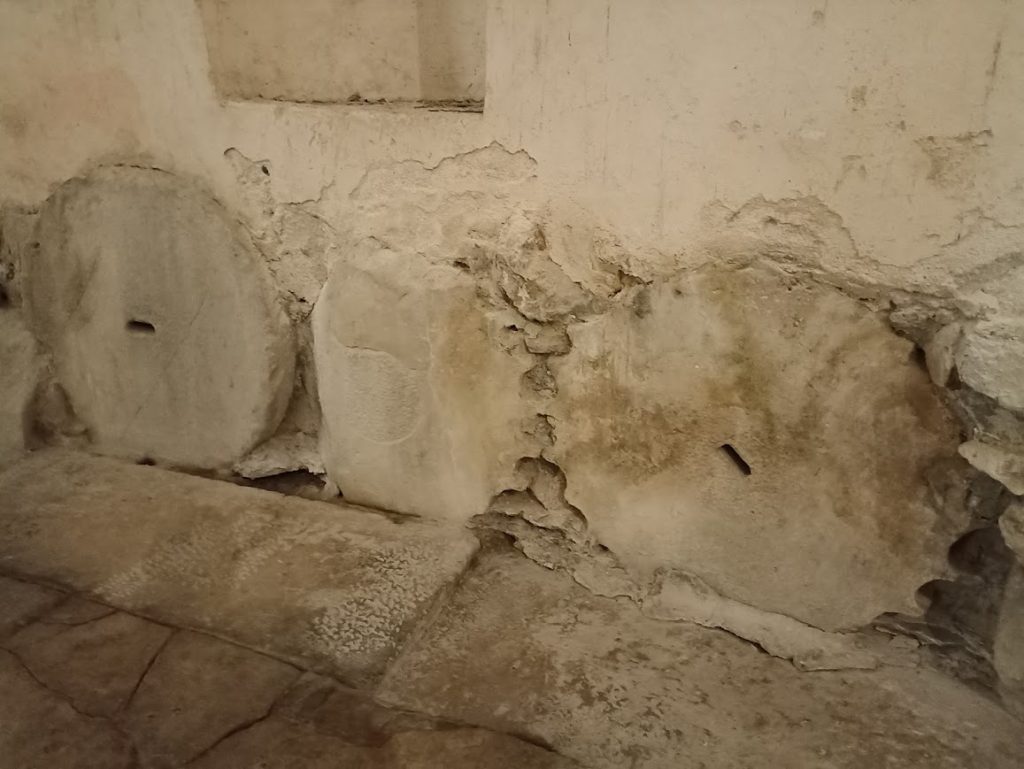
Ancient Roman column drums that form the base of the Church of St Donatus.
NEW POLITICAL TREMORS IN THE HIGH MIDDLE AGES
Zadar remained the political heart of Byzantine Dalmatia throughout the tenth century. Yet even then, the city was already behaving less like a distant provincial outpost and more like a self-assured maritime commune. It pursued an almost independent policy and developed a notably high degree of autonomy. Meanwhile, the Croatian dukes and kings dominated Zadar’s hinterland, and the city increasingly fell under Slavic influence.
The eleventh and twelfth centuries were restless, contested, and diplomatically complex, and they saw Zadar change hands several times. At times it was governed by the Venetian Republic, at others by the Croatian Kingdom, and in 1105 the city recognised the authority of King Coloman, the Croatian-Hungarian ruler. From this era, we also have a famous inscription, carved into the bell tower of St Mary’s Church, which records Coloman, King of Hungary, Dalmatia, and Croatia, as patron of the tower’s construction.

The inscription bearing King Coloman’s name on the capitals in the Church of St Mary. Source: https://www.enciklopedija.hr/clanak/koloman
In the following centuries, Croatian influence in Zadar strengthened further. Few episodes capture this better than the visit of Pope Alexander III in 1177. The citizens welcomed him warmly, and historical documents note that they sang to him “in their Slavic language”. This small detail speaks volumes about identity, language, and the cultural atmosphere of the city at the time.
The most devastating medieval assault came in 1202, during the Fourth Crusade (1202–1204 AD). The Doge Enrico Dandolo enlisted crusaders to seize the city. Zadar was heavily damaged and looted, and much of the population was displaced. Yet the city’s life did not end there. Recovery followed, and governance soon passed into the hands of Venice: The Republic of St Mark. A new political upswing then arrived under the Croatian–Hungarian king Louis I of Anjou, who, after prolonged warfare, entered Zadar and reinforced royal power across Dalmatia. The Peace of Zadar (1358), signed with Venice, brought the city back into the Croatian–Hungarian realm for the next half century.
And while high medieval politics were turbulent, the period was also profoundly productive architecturally. Zadar gained a remarkable sacral landscape, fragments of which are still visible today: parts of St Anastasia’s Cathedral, the Benedictine church and convent of St Mary, St Chrysogonus’ Church, and St Francis’ Church with its Franciscan monastery, an imposing Gothic complex that continues to shape the city’s historical silhouette. Zadar is also home to Croatia’s most precious medieval masterpiece of goldsmithing: a silver gilt chest containing the relics of St Simeon the Godbearer, made in 1380 and preserved in the city’s Church of St Simeon.

The church and convent of Saint Mary
ZADAR IN VENETIAN HANDS
The final chapter of Croatian–Hungarian royal rule over Zadar came in 1409, when King Ladislaus of Naples sold Dalmatia to the Venetian Republic for 100,000 gold ducats (or approximately 760.8 pounds of fine gold!). Under Venetian administration, Zadar retained only limited autonomy and the city council was subordinated to a Venetian-appointed count. Economic life, too, was aligned closely with Venetian interests, though until the end of the 15th century, Zadar’s trade nonetheless continued to develop.
The sixteenth century brought a new and formidable threat, the Ottoman Turks, whose expansion across the Balkans drew alarmingly close to Zadar. Despite centuries of conflict, the Ottomans never captured the city. The danger, however, was real enough to spur Venice into action. Zadar was encircled by a powerful fortification system. A broad belt of walls was rapidly constructed, reinforced with bastions, and complemented by the building of the Sea and the Land Gate.

Zadar’s Land Gate, with the fortifications stretching off in the distance on the seaward side
The Land Gate remains a masterpiece of architecture, and even today the identity of its patrons is carved into stone. Above the central entrance stands a large sculpture of the winged lion, the unmistakable symbol of St Mark and of Venetian state power. Centuries later came a notable modern recognition. In 2017, Zadar’s city walls were added to the UNESCO World Heritage List, together with five other components of Venetian defensive architecture from the sixteenth and seventeenth centuries across present day Croatia, Italy, and Montenegro. They are celebrated as an outstanding example of a maritime fortification system.

Centrepiece of the gate is the large sculpture of the winged lion, a formidable symbol of Venetian state power
NAPOLEON AND THE AUSTRIAN ERA IN ZADAR
During Venetian rule, Zadar functioned as the main political and administrative centre of Venetian possessions on the eastern Adriatic, serving as the seat of the general provveditore of the Province of Dalmatia and Albania. Although the expulsion of Ottoman forces from the hinterland in the late 17th century seemed to herald a calmer age, 1797 brought another dramatic shift. Napoleon toppled the Venetian Republic, ushering Zadar into a period of new political turbulence.
For a time, the city was governed by the Habsburg Monarchy (1797–1806), then by the French (1806–1813). Zadar remained the seat of the regional government, while French rule introduced modernisation in administration and the judiciary. A network of new roads was also built, strengthening overland connections with the hinterland. In 1806, Zadar printed a newspaper in which Croatian appeared in print for the first time, published alongside Italian.

Front page of the first issue of Kraglski Dalmatin (Il Regio Dalmata), the first newspaper published in the Croatian language Source: Wikimedia Commons
Afterwards, Habsburg administration returned. Zadar retained its status as the capital of Dalmatia, becoming the seat of the Dalmatian Parliament and the region’s ecclesiastical metropolis. It is therefore no surprise that Zadar became a focal point of the Croatian national and cultural revival in Dalmatia, with numerous institutions founded to promote the Croatian language and culture. At the same time, a significant share of the city’s population was of Venetian origin and inclined toward politics of Italian affiliation. An internal tension with Croatian population would intensify in the decades that followed…
IN THE GRIP OF THE HARSH POLITICS OF THE FIRST HALF OF THE TWENTIETH CENTURY
At the beginning of the 20th century, Zadar became a stage for a fierce political contest between residents who emphasised the city’s Croatian (or broader Slavic) identity and those who aligned it with the Italian world. After the First World War, Zadar briefly found itself within the State and then the Kingdom of Serbs, Croats, and Slovenes. But the Treaty of Rapallo (1920) attached Zadar, along with some other Croatian territories, to Italy as her enclave on the eastern Adriatic.
What followed was a period of intense Italianisation, Croatian emigration, and economic stagnation as the city was increasingly cut off from its hinterland. One striking architectural legacy of this era is the City Hall on Zadar’s People’s Square (Narodni trg). Built in 1934 on the site of an older, unremarkable town hall, it employed architectural elements characteristic of Fascist-era Italy. Through arches and corner towers, the architects aimed to evoke the grandeur of the Italian Renaissance. The façade bears reliefs depicting other cities: Koper, Pula, Šibenik, Split, and Dubrovnik. When these reliefs were created in 1935, only Koper and Pula lay within the Kingdom of Italy. The other cities represented Italian expansionist aspirations that would soon turn into a harsh reality.

The City Hall on Zadar’s People’s Square, a typical example of Fascist era architecture. Source: Krešimir Sorić / https://www.057info.hr/vijesti/
With the onset of the Second World War, the Zadar region became an Italian occupation zone. By royal decree in May 1941, annexation was formally enacted, and the Governorate of Dalmatia was established with Zadar as its seat. Anti-Fascist forces bombed the city in 1943 and 1944, primarily aiming to destroy the port and prevent German attempts to threaten Allied troops in northern Italy. The bombing brought immense tragedy. More than 60% of the historic centre was utterly destroyed. By the end of 1944, Zadar had been incorporated into Yugoslavia.

A photograph of heavily destroyed Zadar as a result of bombing during the Second World War. Source: https://vojnapovijest.vecernji.hr
THE RISE OF A CAPTIVATING CROATIAN DESTINATION
After the Second World War, Zadar was gradually rebuilt. The population grew significantly, the Italian community lost its former social prominence, and the number of Italians in the city decreased sharply. During the 1980s, Zadar ranked among the most economically developed cities in Croatia and Yugoslavia.
In 1991, at the beginning of the Croatian War of Independence, Zadar was attacked several times. Peace only fully returned in August 1995 following a military-police operation Oluja (Operation Storm).
Today, Zadar is one of Croatia’s most visited tourist destinations, a city with a rich cultural and historical offering where every lover of heritage can find something to admire. It is also a city of great maritime beauty with a strikingly blue sea and, according to Alfred Hitchcock, the place with the most beautiful sunset in the world. Visitors now flock to the north-western edge of the peninsula to see whether they agree. It was also here that two unusual contemporary landmarks appeared in the early 2000s. The first is the Sea Organ, whose music is created by the energy of the sea, through waves and tides - the breathing rhythm of the Adriatic itself. The second is the Greeting to the Sun, an installation of large solar panels on the waterfront representing the Sun and the eight planets of the solar system.
Beyond archaeology and history, Zadar is also a home of excellent gastronomy. Its dishes reflect both continental and maritime traditions, and while the offer of freshly caught fish is an obvious highlight, visitors should not overlook one distinctly local signature - Maraschino, Zadar’s celebrated cherry liqueur, an essential part of the city’s flavour and a fitting toast to a place shaped by centuries of sea, stone, and shifting empires.
To visit Zadar with one of our expert guides, sign up for our wonderful gulet trip, Cruising the Dalmatian Coast: from Šibenik to Zadar.

The sunset in Zadar reflected on the solar panels of the Greeting to the Sun installation. Source: https://www.zadar.hr/hr/dozivljaji/povijest-i-kultura/morske-orgulje-i-pozdrav-suncu.


Leave a Reply