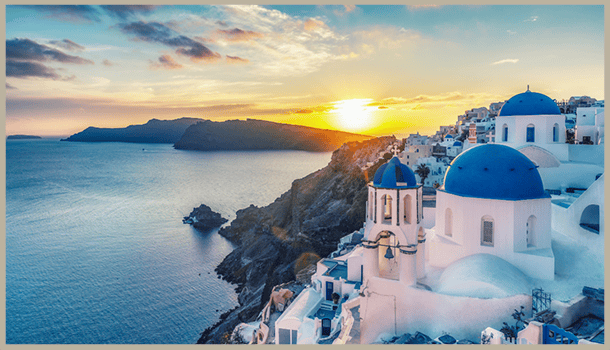
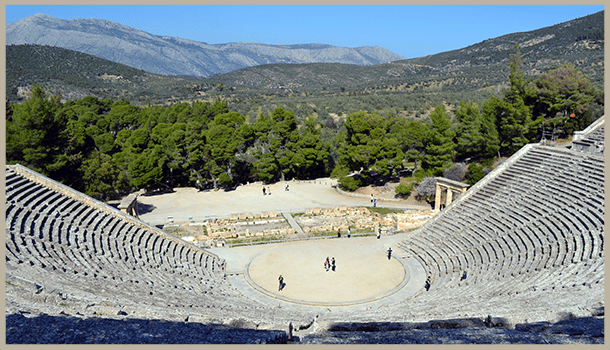
This is a small‑group, expert‑led cultural cruise that travels the full length of the Greek Dodecanese islands, plus Samos, visiting eleven islands and three UNESCO World Heritage Sites. Instead of going port to port at night like many large cruise ships, we travel slowly during the day, so you can truly appreciate the Aegean landscapes and seascapes. We then explore each island and its key historical sites — from the Asklepieion of Kos to the medieval fortifications of Rhodes and the sacred landscapes of Patmos. It’s a rare chance to experience both world‑famous monuments and intimate, off‑the‑beaten‑track villages.



Fitness Level

One of ‘Greece’s top three cultural holidays’ – The Telegraph
One of the ’50 Best Holidays in Greece’ – The Times (UK)
This spectacular gulet cruise in Greece, takes you through the entire Dodecanese chain (plus the island of Samos), beginning with the famous island of Kos and including eleven of the most beautiful and evocative of the Greek islands, such as Patmos, Nisyros and Kalymnos, and no less than three UNESCO-listed World Heritage sites.
The islands’ strategic location, between the open Aegean and the mainland of Asia Minor, has made them a well-connected cultural interface throughout history. Carians, Greeks, Romans, Byzantines, Venetians, the Crusader Knights of St. John, Ottomans and Italians visited or settled them, leaving behind a rich legacy of grandiose ancient sanctuaries, mighty castles, serene monasteries and traditional villages, all set within an ever-changing maritime scenery.
The sites you see on this itinerary include world-famous relics, like the Asklepieion of Kos, the extraordinary archaeological museum of Samos, or the medieval fortifications of Rhodes, each among the best of their kind. On the smaller, off-the-beaten-track islands you gain a more intimate view of traditional Greek island life, with their picturesque harbours, village squares adorned with pebble mosaics, and beautiful domestic architecture. These islands are also rich in diverse landscapes: craggy hilltops, strange volcanic formations, and of course coastlines featuring a succession of bays and islets. Another highlight of the cruise are the series of meals you will enjoy at selected venues throughout the islands, ranging from home cooked local cuisine in family-run tavernas to real gourmet food, the finest the region has to offer.
Sightseeing aside, your stylish gulet will moor in secluded coves, allowing you to bathe in azure seas, admire the pristine scenery, or simply relax. From fabulous food to epic history, this is a fascinating journey through Greek culture, past and present. Don’t miss it!
Prefer a shorter tour? We have a 1-week version of this trip – Cruising the Aegean: From Kos to Patmos
Our Tours receive an average rating of 5 out of 5 from over 950 reviews, according to AITO reviews.
Day 1: Our gulet awaits you in Kos Harbour. Welcome drinks and dinner on board.
Day 2: We cross to Pothia, the capital and port town of Kalymnos. The attractive settlement, surrounding the harbour in a strikingly theatrical setting, is dominated by houses and mansions from the 19th and early 20th centuries, witnesses to the island’s erstwhile wealth acquired by its large fleet of sponge-diving vessels in that period. We walk through the streets and lanes to visit the excellent local archaeological museum, one of the biggest surprises in the Dodecanese. It serves as a great introduction to the archaeology of the Aegean Islands and is especially notable for its unusually fine collection of Archaic and Classical Greek sculpture, including the stunning Lady of Kalymnos, a near-fully preserved bronze statue of a woman recovered from the seabed near the island. Back in port, we learn about the tradition of sponge-diving (Kalymnos is the last Aegean Island to retain a sponge-diving fleet) and about the properties of that unique natural product. Weather permitting, we continue north to the bay of Panteli on Leros.
Day 3: We visit Leros today, where we have much to explore. We begin in Lakki Town, once Porto Lago, an Italian military town of the 1930s, built in the style known as ‘razionalismo’, an odd combination of stark fascist aesthetics, Bauhaus modernism and Art Deco eclecticism. Next we explore the Castle of Panteli, visible from most of Leros, which is really three castles, one built around the other in succession, exemplifying the structural differences between an eleventh-century Byzantine fortification, one built by the Crusader Knights of Saint John in the fourteenth century, and the Knights’ own fifteenth-century modification, a reaction to the introduction of gunpowder. In the castle’s chapel, we catch a glimpse of the miracle-working icon of the Virgin of the Castle. Here, we also learn about the events of the pivotal Battle of Leros in October and November of 1943, when, despite a desperate Allied intervention, the island fell from Italian to German control. In the afternoon we make the journey to the holy island of Patmos, and a dip in Grikos Bay. We dine on board.
Day 4: Having breakfasted, we make our way to Patmos harbour and set out to explore the island. Patmos is where Saint John is believed to have received his vision of the Apocalypse. As a result, it has been a centre of Christian worship for many centuries. We explore the resulting Byzantine riches, inscribed by UNESCO as a World Heritage site. At the monastery of the Revelation, we find a medieval church grafted onto the cave said to be the venue of John’s account, a place of dense atmosphere and dignity. The main Monastery of Saint John, founded nearly a thousand years ago by the Blessed Christodoulos, is one of the chief Byzantine treasures in the Aegean, sternly fortified on the outside, and serene and beautiful within, with superb frescoes revealing the full splendour of Late Byzantine art, of a quality we would expect to find in a metropolitan centre like Constantinople or Thessaloniki. The monastery museum houses rare treasures, including fragments of the most famous Byzantine book, the Purple Codex, and an icon by Domenikos Theotokopoulos, the Cretan painter later known as El Greco. The monastery is surrounded by the immensely picturesque Chora, a fine town of traditional mansions from the last four or five centuries.
After lunch, we leave Patmos behind and set course for Samos, dining aboard.
After lunch, we leave Patmos behind and set course for Samos, dining aboard.
Day 5: A day on Samos. This great island was one of the most powerful Greek city-states in the Aegean, especially during the sixth century BC when it was a place of great wealth and unusual sophistication and innovation. If we needed proof of that, we’re more than answered by our first site.
We visit the Heraion, one of the most important shrines in the region, said to be the birthplace of the goddess Hera, and the site of her wedding with Zeus. The sanctuary, another World Heritage site, set in an atmospheric wetland area by the sea, was richly embellished, especially with the huge Temple of Hera, built and rebuilt in the sixth century BC. The massive foundations and the single standing column allow us to appreciate the lost grandeur of this vast structure. After lunch, we make our way to the island’s modern capital, Vathy, where the archaeological museum contains the rich finds from the Heraion, including fantastic examples of early Greek sculpture. Among these is a stunning colossal kouros, an Archaic statue of a nude young man and the largest known piece of its kind.
There is also a vast array of small finds, among them bronzes from all over the eastern Mediterranean and even further afield, rare carvings in ivory and wood, and much more. In the afternoon, we return to the boat and swim off the beach before dinner in Pythagoreio. This charming port village was built on the ruins of the ancient island capital. In antiquity, it was called Samos, like the island itself, but today it bears the name of the island’s most famous son, Pythagoras.
We visit the Heraion, one of the most important shrines in the region, said to be the birthplace of the goddess Hera, and the site of her wedding with Zeus. The sanctuary, another World Heritage site, set in an atmospheric wetland area by the sea, was richly embellished, especially with the huge Temple of Hera, built and rebuilt in the sixth century BC. The massive foundations and the single standing column allow us to appreciate the lost grandeur of this vast structure. After lunch, we make our way to the island’s modern capital, Vathy, where the archaeological museum contains the rich finds from the Heraion, including fantastic examples of early Greek sculpture. Among these is a stunning colossal kouros, an Archaic statue of a nude young man and the largest known piece of its kind.
There is also a vast array of small finds, among them bronzes from all over the eastern Mediterranean and even further afield, rare carvings in ivory and wood, and much more. In the afternoon, we return to the boat and swim off the beach before dinner in Pythagoreio. This charming port village was built on the ruins of the ancient island capital. In antiquity, it was called Samos, like the island itself, but today it bears the name of the island’s most famous son, Pythagoras.
Day 6: Samos still has some amazing sites to share with us. We begin with the famous Tunnel of Eupalinos, a precocious wonder of ancient Greek engineering. Another achievement of the island’s golden age in the sixth century BC, it is cut through sheer rock for a length of over a kilometre. It served as the base tunnel for an aqueduct which runs in a separate tunnel below its floor, supplying the city of Samos with fresh water while being invisible to any attacker or besieger.
The story of how the tunnel was made, by teams working towards one another from both ends, has been painstakingly reconstructed by archaeologists and is truly marvellous. Next, we visit the superb and state-of-the-art archaeological museum of Pythagoreio, a carefully designed exhibit that strives to present the history of this age-old settlement and to bring the life of the ancient city of Samos back to life: its prehistory, its shrines, its graves, its art and its domestic life.
After lunch on board, our next destination – and our next swim – await: Leipsoi.
The story of how the tunnel was made, by teams working towards one another from both ends, has been painstakingly reconstructed by archaeologists and is truly marvellous. Next, we visit the superb and state-of-the-art archaeological museum of Pythagoreio, a carefully designed exhibit that strives to present the history of this age-old settlement and to bring the life of the ancient city of Samos back to life: its prehistory, its shrines, its graves, its art and its domestic life.
After lunch on board, our next destination – and our next swim – await: Leipsoi.
Day 7: A day of pure relaxation, filled with swimming opportunities and time for reading and chatting, as we cruise south to the island of Pserimos where we will anchor overnight.
Day 8: We make an early morning crossing to the island of Kos and breakfast in the shadow of the harbour castle. Founded in 366 BC as a ‘synoikism’ of the earlier Koan cities, Kos Town quickly became one of the main commercial centres in the Dodecanese, famed for its wine and set on one of the major Mediterranean trade routes. The destruction of its later successor by a devastating earthquake in 1933 led to a major rebuilding by the Italian authorities then in control of the island, and to a series of excavations, many of which are preserved as archaeological parks within the new town: a charming juxtaposition of old and new. We visit the ancient harbour quarter and the agora or market, the meeting space defining an ancient city, and the superb archaeological museum, displaying the city’s history from prehistory to the Roman era. Its collection of sculpture is superb, featuring many depictions of Greek mythological characters, as well as a wealth of other fine finds, throwing light on many aspects of the wealth and sophistication of ancient Greek and Roman Kos.
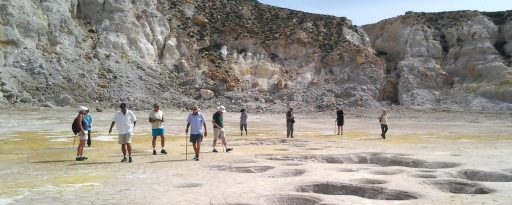
After lunch on board we cruise south to the island of Nisyros where we travel inland in the late afternoon to see the stunning fortifications at Paliokastro, one of the best examples of military architecture of the Classical to Hellenistic eras in the Greek Islands, in a superb setting overlooking the sea. Then, we continue to a viewing point at the rim of the caldera, the volcanic centre of Nisyros, to gaze down into the Stefanos steam crater, estimated to be about four thousand years old. It is a fascinating place, offering deep insights into a geologically volatile region. We dine at Emporio.
After lunch on board we cruise south to the island of Nisyros where we travel inland in the late afternoon to see the stunning fortifications at Paliokastro, one of the best examples of military architecture of the Classical to Hellenistic eras in the Greek Islands, in a superb setting overlooking the sea. Then, we continue to a viewing point at the rim of the caldera, the volcanic centre of Nisyros, to gaze down into the Stefanos steam crater, estimated to be about four thousand years old. It is a fascinating place, offering deep insights into a geologically volatile region. We dine at Emporio.
Day 9: We set out for Tilos this morning, the ‘greenest’ island in the Dodecanese. Tilos is the first Aegean island to rely entirely on renewable energy, and the only island to ban all bird-hunting. After swimming in an island bay we moor at the jetty of Tilos and begin our exploration of this island by viewing a unique side to Tilos’ buried past - palaeontological finds of the island’s extinct species of pygmy elephant. These odd mammals, apparently survivors of a wider-spread species that got stranded after the last ice age(s) in many islands from Sicily via Crete to the Dodecanese, appear to have continued on Tilos until fairly recently: 6,000 years ago. We continue on to the recently opened archaeological museum to learn something of the more recent past, and then spend the entire afternoon relaxing and swimming in these beautiful waters.
Day 10: A short crossing takes us to Chalki. Here we travel inland to the abandoned former main village or Chora. We ascend a steep slope (the most demanding walk on this itinerary), covered in crumbling terrace walls, houses and chapels, all crowned by the mighty walls of another castle of the Knights of Saint John. As we approach the various structures, we discover that there is more to the place: the medieval buildings of the village and castle stand on mighty predecessors: the remains of a large ancient Greek city, with vast terrace walls, bases for statues and dedications, rock-cut cisterns and a mountain-top citadel. Atop, we are rewarded by wonderful views across the local seas and over to Rhodes. There is time to wander the lanes of the lovely port town before we cross over to the island of Alimnia to swim and spend the evening at anchor.
Day 11: A long and scenic morning cruise brings us to the great island of Rhodes. We moor just below the medieval city walls of Rhodes Town. a major centre in Antiquity, in the Middle Ages, and now. The city of Rhodes was founded in 408 BC by a ‘synoikismos’, a moving-in-together of the earlier cities of Ialysos, Kameiros and Lindos, which changed the fate of the island and its surrounding region. A major regional power in the Hellenistic period, after Roman and Byzantine rule, it was taken over by the Knights Hospitaller or Knights of Saint John in 1310. Under these Knights of Rhodes, there was a complete reorganisation of the city, leaving us one of the best-preserved medieval ensembles in Europe, with streets, lanes, squares and houses still following their fourteenth-century outline: a deserving World Heritage site.
We begin in the former Hospital of the Knights of Rhodes, one of the most significant pieces of Crusader architecture in the Aegean. It now houses the island’s main archaeological museum. Its rich trove of treasures is fit for the largest island of the Dodecanese: examples of Rhodian sculpture, sensual and sensitive at the same time, are one of the highlights, but the Hellenistic pebble mosaics, a Macedonian tradition transferred to wealthy Rhodian homes in the third and second centuries BC, are as spectacular. There is also a superb display about the island’s prehistory, when Rhodes was a key recipient of first Minoan and later of Mycenaean influences. We follow with a visit to the grandiose Palace of the Grand Masters of the Knights, rebuilt as a royal residence by the Italian occupants in the 1930s and embellished with many fine Roman mosaics from the excavations in Kos. Wending our way back, we have dinner in Rhodes town.
We begin in the former Hospital of the Knights of Rhodes, one of the most significant pieces of Crusader architecture in the Aegean. It now houses the island’s main archaeological museum. Its rich trove of treasures is fit for the largest island of the Dodecanese: examples of Rhodian sculpture, sensual and sensitive at the same time, are one of the highlights, but the Hellenistic pebble mosaics, a Macedonian tradition transferred to wealthy Rhodian homes in the third and second centuries BC, are as spectacular. There is also a superb display about the island’s prehistory, when Rhodes was a key recipient of first Minoan and later of Mycenaean influences. We follow with a visit to the grandiose Palace of the Grand Masters of the Knights, rebuilt as a royal residence by the Italian occupants in the 1930s and embellished with many fine Roman mosaics from the excavations in Kos. Wending our way back, we have dinner in Rhodes town.
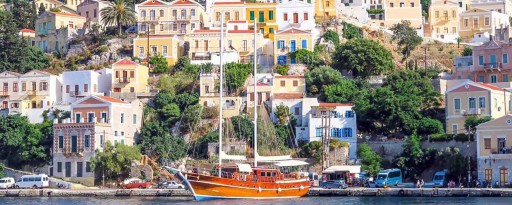
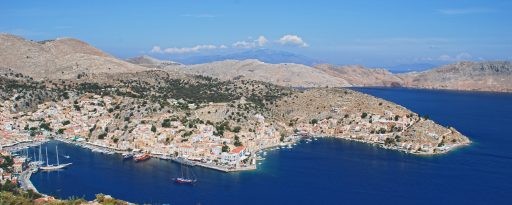
Day 12: Our morning is given over to medieval Rhodes. We start by walking through the huge rock-cut moat, reflecting the Knights’ increasing sense of insecurity in the changing geopolitical theatre of the fourteenth and fifteenth centuries, a fine example of medieval defensive architecture. Then, we set out for the island of Symi. Weather permitting, we stop for a chance to swim in a pretty cove below steep cliffs. Once we continue, we are eagerly watching on deck as we enter Symi’s lovely neoclassical port town, one of the loveliest sights in the Mediterranean, built on nineteenth-century affluence from sponge-trading and shipbuilding. Striking pastel-coloured homes cascade down the slopes towards the harbour.
Day 13: We have an early morning wander through Symi’s winding and stepped streets, making our way from the harbour settlement up the traditional main artery, the many-stepped Kali Strata (‘beautiful street’) to the upper village. Along the way, we admire its many fine mansions, all following the same basic design but featuring an endless variation of Neoclassical façade decorations, revealing the great wealth that was once concentrated on this tiny and rocky island. In the afternoon we depart for the volcanic islet of Giali, for a leisurely swim in a place of unique archaeological heritage. For thousands of years, it was important as one of only two sources of obsidian, the natural volcanic glass that was used in prehistory to make supremely sharp cutting tools. In recent years, it has also produced high-quality pumice and perlite, two distinctively volcanic resources.
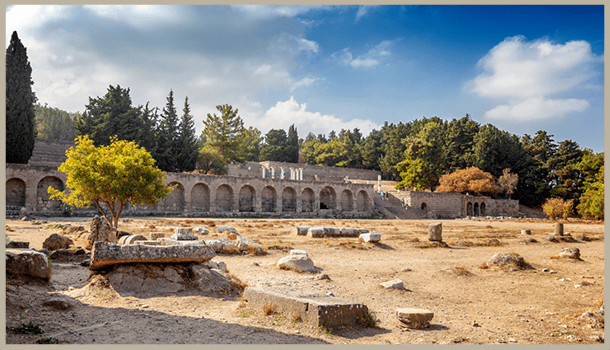
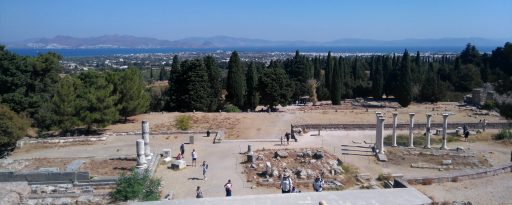
Day 14: After plenty of time to breakfast and swim at leisure, we set out for our final visit of the cruise, and one of the most magnificent: the great sanctuary of Asklepios, the God of Healing, on the island of Kos. A place revered across the ancient world. Its remains, set on a slope with wonderful views across the straits to Asia Minor, are a key example of Late Classical architectural planning and drew the hopeful and fearful from a wide swathe of the ancient world in search of the god’s help. With this stunning final reminder of the wonders of the islands, we sit down to our final on-board dinner and toast the splendours that we have seen over the preceding fortnight.
Day 15: Transfers to Airport.
NB: The itinerary on this cruise is likely to change slightly according to the weather conditions. Some modifications regarding the order or days of crossings, or visits are likely to occur.
NB: The itinerary on this cruise is likely to change slightly according to the weather conditions. Some modifications regarding the order or days of crossings, or visits are likely to occur.
I would like to book, what else do I need to know?
For information not covered below please refer to our FAQ’s or contact us directly on [email protected]
Arrival and Departure Information
Arrival Airport – Kos
Departure Airport – Kos
Arrival Location – Kos Harbour (approx. 30 mins from airport)
Departure Location – Kos Harbour (approx. 30 mins from airport)
Embarkation and departure is planned for approx.17:00. You are more than welcome to arrive earlier to drop off your bags, but please be aware that the crew will be busy cleaning and tidying making everything ready for your group so you will not be able to settle into your cabin.
If your travel plans or flights do not allow you to arrive before 17:00 we recommend arriving the day before the tour starts. This would also allow time to relax, recover from any jet lag and arrive at the boat on time for embarkation and departure.
If you arrive at the gulet after 17:00, we will do our best to enable you to join the tour at a later time and place.
Please Note: Departure time is subject to change depending on weather, harbour, or other conditions.
Disembarkation is around 09:00. We will arrange local transfers on the first and last day of the tour.
Booking Flights If you are staying in or connecting via Athens then the easiest way to get to and from the gulet is to fly. There are a number of airlines that offer domestic flights in Greece. The cheapest way to book flights is directly with the airline online.
Please note: Flights are subject to change. Please contact the airline for exact details.
If you prefer to book with a travel agent, we are happy to recommend specialists in a number of countries around the world, please contact our office for more details.
Travel Insurance:We consider adequate travel insurance to be essential. You should ensure that you take out a suitable policy, to make sure that your trip is properly covered.
The European Union’s Entry/Exit System (EES) and the European Travel Information and Authorisation System (ETIAS).
The Entry/Exit System (EES) is a new digital border management system for registering non-EU nationals travelling for a short stay, each time they cross the external borders of 29 European countries using the system. The EES will modernise border management of the Schengen countries, gradually simplify border controls and prevent identity fraud. ETIAS travel authorisation is an entry requirement for non-EU visa-free nationals.
You find out more about EES & ETIAS using the link below
https://travel-europe.europa.eu/pb
Visas
For UK Nationals, You can travel without a visa to the Schengen area, which includes Greece, for up to 90 days in any 180-day period without a visa.
Citizens of European Union or Schengen Treaty member states need no visa for Greece, those from the United States, Canada and Australia do not need to apply for a visa to visit Greece for trips of less than 90 days duration.
Athens, Kos and the Greek islands If you are planning to stay in Athens before or after your tour or if you intend to add time on Kos or any other Greek island, we are happy to offer information and advice.
Nature of the Cruising the Dodecanese itinerary Cruising and Itinerary: This fabulous cruise through the Aegean, visits 11 of the Dodecanese Islands and has a character very different to that of most of our other gulet cruises. We will be crossing some stretches of wide open sea between the islands and covering considerable distances on some of the days. The Dodecanese Islands (running as a chain alongside the shore of southwest Turkey) are renowned for their wealth of nature and beauty and cruising between them offers a wonderful opportunity to experience and appreciate their fascinating diversity. There will be some early starts so we can make passage in the early morning before the wind picks up in the afternoon. While the average travelling time will be longer than our normal coastal gulet cruises, there will be opportunities to swim each day (schedule and weather permitting).
As with all of our gulet cruises, we have spent a great deal of time crafting the itinerary to be as good as it can be, but we are travelling aboard a boat and may need to make changes according to the weather and the captain’s advice.
Overnights: Compared with our coastal gulet cruises in Turkey, where we tend to spend a good number of nights moored out in isolated bays, on this trip we will be spending more nights in harbour on the islands. This means you’ll have the chance to explore not only as part of the expert led outings, you’ll also be able to go ashore and wander in the mornings and evenings when we are tied up in the picturesque Greek harbour towns.
Food: The boat is a Greek flagged gulet with both a Greek and Turkish Captain and a Turkish crew including a chef who will be cooking up wonderful meals throughout your cruise. As such the food served on board will be traditional ‘Turkish’ or Eastern Mediterranean. We will be going ashore to eat authentic Greek food in family run tavernas at intervals along the way and your tour leader will ensure you’ll have the chance to sample a good many of the local Greek delicacies of the islands. The gulet will be stocked with Greek wine and spirits and your guides will introduce you to some of the best beverages (alcoholic and non-alcoholic) the Greek islands have to offer.
Tour Includes:
Cruising aboard the 8-cabin gulet Athen A
Full board accommodation with water, tea and coffee and wine with dinner
Airport transfers on the first and last day of the tour
Travel by private minibus
Harbour fees and crew services
All entrance fees and tips on land
The services of your expert tour leaders throughout the entire trip
WiFi (coverage permitting)
Not included:
Flights and airport taxes
Visas
Travel insurance
Gratuities on the gulet. It is customary to tip the crew at the end of a tour (we recommend a minimum of 20Euro per day per guest)
Tips for guides
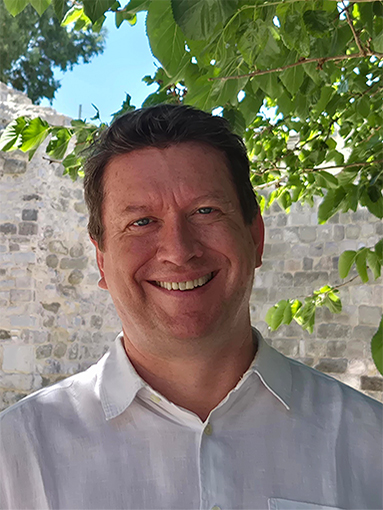
Michael Metcalfe
Michael earned his PhD at University College London, focusing on the ancient Greek cities in the Eastern Aegean Islands and Western Turkey. While finishing this research, Michael lived and worked in Athens and Ankara as well as London, and took up his first academic post as Assistant Professor in Ancient History at The Mediterranean Center for Arts and Sciences in Sicily, before joining Peter Sommer Travels full time in January 2009. A specialist in Greek and Latin inscriptions and social history, Michael is currently studying the unpublished diaries of early British Travellers to Greece, Turkey and Sicily, and is involved in publishing inscriptions from many parts of the Eastern and Central Mediterranean. Michael co-edited the Blue Guide to the Aegean Islands and has been contributing editor to the last two editions of the Blue Guide to Sicily.
Michael has designed and led many of our tours, and received rapturous praise. Not only is he 'enthusiastic, charming, and knowledgeable', he is also a natural born organiser. We are delighted to have him as one of our key team.
What previous guests have to say about Michael:
"Michael was an outstanding guide / tour leader. He was a delight to listen to. He brought the archeological sites to life with his passionate interpretation and stories. His love for the land he stood upon was evident throughout our travels." Yvonne McGrath
"Michael was excellent. He has a great sense of humour and was a wonderful and engaging story teller with extraordinary recall of detail. I have done many guided tours with other companies but this one was certainly the best ever. I am unable to suggest any improvements!" Dianne Truss
"Michael's subject matter knowledge, ability to connect with all the tour guests, organizational and interpersonal skills was an absolute highlight of the tour. An amazing guide, super knowledgeable with the latest research. I learned more about Greece in 2 weeks than I learned in school and in the last 60 years! Michael (and his fellow guide Nota) were the BEST EVER guides we had (and we have travelled with many from other companies before)." Constantin Delivanis
"This is the first organized tour we have ever participated in. I think the bar is very high for us now! Michael (and his fellow guide Nota) were wonderful tour guides, so knowledgeable, patient and considerate of all of the participants. We couldn't have asked for better guides. They managed to convey a huge amount of history in an organized way, brought it all alive with stories, and took us to local tavernas with delicious food." Alison Kibrick
"Michael was an exceptional guide. His 'stories' - carefully planned potted histories based on the sites visited - seamlessly knitted together to provide, by the end, a comprehensive survey of the history of the Peloponnese from Neolithic cave burials to post-war Greek politics. I particularly admired his ability to incorporate the uncertainties of scanty evidence and interpretations in talks designed for an intelligent but general audience. Excellent." Nigel Berry
"This was our third trip with Michael and valued his usual flair for imparting his knowledge with such verve and expertise. It was good to be in his company once again. The exceptional guiding by Michael and his fellow guide Nota was a higlight of the trip, they shared their passion and knowledge of the Peloponnese in such an engaging way. We were immersed in the history and archaeology so completely that we felt ourselves back in ancient times. It was a sheer pleasure to tour the Peloponnese in its springtime glory in the company of our enthusiastic, knowledgeable and charismatic guides Michael and Nota who brought history, archaeology and culture to life with such verve. We loved every moment of this trip - it exceeded our expectations!" Margaret Woods
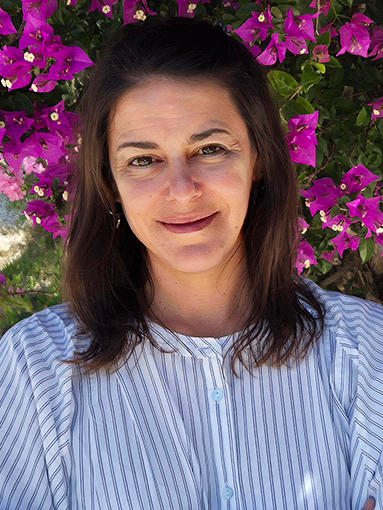
Nota Karamaouna
Born and bred in Athens, Nota has been travelling to Turkey, especially Cappadocia, for many years, captivated by its multicultural history, the spectacular landscape and the warm local hospitality. With a degree in Archaeology and Art History and a Masters in Byzantine Archaeology, she is currently finishing her PhD. at the École Pratique des Hautes Etudes in Paris, focusing on the Byzantine churches of Cappadocia.
Nota has excavated and surveyed at a number of sites in Cappadocia and elsewhere in Turkey, and at sites in Greece, ranging from the island of Kos to central Athens. Alongside her academic studies she has worked for a specialist Byzantine photo-library and the Byzantine Museum of Athens. A native Greek-speaker, she is fluent in English and French (and is picking up Turkish too) and puts her language skills to use as a freelance translator and editor. We are very pleased Nota will be sharing her passion and expertise with our guests.
What previous guests have to say about Nota:
"My husband and I thought the guides/ tour leaders were sensational. You could not ask for better. Nota was so lovely, friendly and extremely knowledgeable ! I have nothing but praise for Nota. My husband and I consider Nota and fellow guide Michael highlights of the tour!" Yvonne McGrath
"Nota was top notch. Nota's enthusiasm and profound knowledge of all things Byzantine was a wonder. Its hard to improve on perfection. This was our favorite tour ever! Nota made sure that people with special dietary needs were accommodated and went above and beyond by looking after a member who had to go to the hospital. Nota and Mike, our guides, were exceptional; very knowledgeable and accommodating. This tour really was an investment in memories. It was expertly crafted, perfectly executed, and delivered an unforgettable journey through the Peloponnese rich with culture, history, and natural beauty. Thanks to Nota and Mike, this tour was truly an experience of a lifetime." Clint Cragg
"Nota has vast and detailed knowledge of the ancient sites, and her explanations are engaging and interesting. I really appreciate the way she went the extra mile to ensure that I had special dietary food, which was of the highest quality. Both Nota (and her fellow guide Michael) were friendly, kind and excellent company. Cruising the Cyclades with Michael and Nota was my second Peter Sommers trip, I cannot recommend it too highly: all the site and museum visits were interesting and informative, and the whole trip was great fun. I am looking forward now to a third Peter Sommers experience." Eilidh Macleod
"This has been my 2nd tour with Nota. I would do another with her any time. One of her many talents is an ability to relate personally with people without losing her professionalism. She is especially caring. Ten out of 10!" Anne Lancashire
"Nota's passion for the history and culture are always evident, and her energy was admirable. Always friendly and engaging. As regular travellers on Peter Sommer tours we were delighted to find the Dodecanese cruise offered the same winning combination of a fascinating itinerary with excellent guides. Their grasp of the history, archaeology and culture added enormously to the experience." Ian Suckling
"Nota was outstanding, she couldn't have been a better tour guide - her knowledge was very wide and she was engaging. She was very kind and helpful. Her organisational skills were exceptional. I would definitely travel with her again." Elizabeth Whyte
"Nota (and fellow guide Michael) were extraordinary, individually and as a bonus, as a team. They were both SO knowledgeable and obviously passionate about Greek history matched by their enthusiasm to show and share that passion. Nota was always on top of how each person was doing - thank you!! Excellent." Daryl Fields
"Nota is the most passionate subject matter expert that I ever met. Her knowledge about Byzantine history and iconography was simply amazing. Nota and fellow guide Michael were the BEST EVER guides we had (and we have been with many other guides with other companies). My wife and I have travelled to Greece many times; the 2 week Peloponnese tour we took with Peter Sommer Travels was the most educational, fun and best organized tour we ever had. The guides were simply amazing. We plan to take many more of their tours." Constantin Delivanis

What makes this Dodecanese cruise different from other Greek island holidays?
What is life like on board the gulet during this cruise?
Your gulet is a traditional wooden motor‑cruiser, spacious and elegant, with comfortable en‑suite cabins and generous deck areas for relaxing, dining, and watching the islands drift by. Days blend gentle cruising with swimming stops in secluded coves, meals prepared by the onboard cook, and evenings anchored in quiet bays or small harbours. It’s an unhurried, immersive way to experience this crucible of civilisations in the Mediterranean — peaceful, scenic, and wonderfully sociable.
Who leads this tour?
Your journey is led by two of our expert guides, specialists in the history, archaeology, and culture of the Greek islands. They accompany you throughout the voyage, offering insightful explanations at every site. Guests often tell us that travelling with passionate, knowledgeable and erudite guides is what makes a Peter Sommer Travels cultural cruise truly exceptional. Please click on the tour experts’ names under the tour dates to read full bios and testimonials.
Who typically joins this Dodecanese gulet cruise?
Guests tend to be curious, culturally minded travellers who enjoy archaeology, history, good food, and the pleasure of exploring in a small group. With a maximum of around 14 guests, the atmosphere is friendly and sociable, and the presence of two expert guides ensures plenty of personal attention and in‑depth interpretation throughout the journey. It’s ideal for solo travellers, couples, and friends seeking a thoughtful, and life enriching holiday.
What kind of food will we enjoy during the cruise?
Food is a highlight of this journey as it is on all of our tours. You’ll enjoy a mix of freshly prepared meals on board and carefully chosen tavernas and restaurants ashore, ranging from home‑cooked island dishes to some of the finest regional cuisine. Expect fresh fish and seafood, seasonal vegetables and fruits, and local Greek specialities unique to each island. Dietary needs can be accommodated with advance notice.
How physically demanding is the itinerary?
Our Dodecanese cruise is designed for travellers who enjoy gentle walking and exploring historic sites. Distances vary but many visits involve uneven and broken ground, steps, and uphill or downhill paths. The pace is relaxed, and there is always time to enjoy the expert commentary, absorb the atmosphere of a place, or take photographs or appreciate the views. Good walking shoes and a reasonable level of fitness will ensure you get the most from the experience. The tour is rated 3 out of 5 on our intensity scale, meaning it is classed as intermediate. You can find out more by visiting the fitness levels page on our website.