
 Agrigento is quite an assault on the senses. Everywhere there is scale and hugeness. It bespeaks vastness wherever the head turns. In part, this is a contribution of geography, which helpfully arranges the landscape to give you impressive views of the ancient and modern cities’ expansiveness. Modern Agrigento rears up and crashes over the hills that formed the ancient acropoleis like lines of soldiers storming a fortress. The rising ragged lines of the city are not neat and the development of modern Agrigento (a name it’s only had since the 1920s, displacing the medieval and early modern Girgenti) has not always, shall we say, been carefully regulated, but it’s undeniably impressive and provides a majestically huge contrasting backdrop for our view of the ancient city, which for most visitors means the so-called Valley of the Temples; more of that shortly. It’d be a shame to leave the upper city so undersold, because there’s a lot worth seeing there – the modern sprawl is just its outer face. There are beautiful pockets of baroque, neoclassical and medieval architecture there, and a superb cathedral with amazing decoration around the chancel and on the roof beams, magnificently-sited, soaring stupefyingly over a view of green hills bifurcated by dips and valleys. And within all that are ancient treasures, some proudly visible but inaccessible (for now), some splendid and visible, some … hidden – but for the latter we’ll have to show you in person.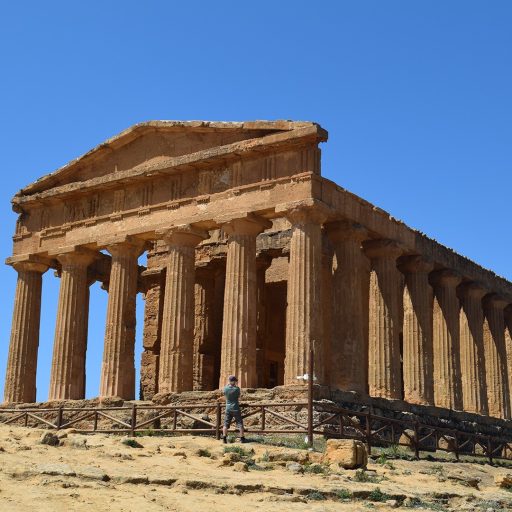
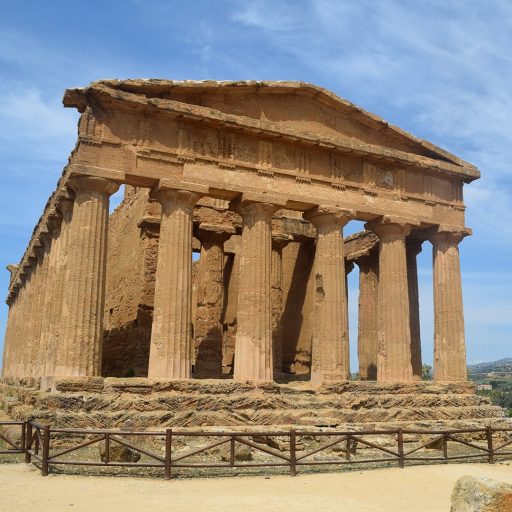
But most people take their main memory of Agrigento as their first sight of the Valley of the Temples far down below, often during the drive to the city, and from long experience there are few who can suppress a gasp as it’s first revealed: as high above, absolutely insisting on your attention is a perfect Greek temple in autumnal brown stone set by some artist against the deepest blue sky. It stands on a high ridge of red sandstone, running a mile or so along, creased here and there like a blanket and running alongside the road. Which means that when you’ve recovered from the first gasp, you’ll be compelled to utter another as a second temple appears and then a third and, well you get the idea, and just for variety, there’s another in the fields and a huge tomb monument at the base of this great rock. Not all of the temples are as well preserved as the first, but here, at the southern fringe of the ancient city, we can already tell that it was powerful and impressive. This all works at night, too: knowing what they’ve got, the Agrigentines ensure the temples are floodlit so that people from less fortunate places can see what they’re missing as they drive by.
Arrived at the top – if you’ve driven, through a descendant of one of the ancient city gates, you find yourself in the ancient city proper: Agrigentum, or to give in the name its Greek founders used, Akragas. Come and stand by that first temple for a moment and look back to that sprawling view of the modern city on the rising hill stretching far off. It seems odd for an ancient Greek city to miss out heights doesn’t it? And that’s where you hear, honestly with something of a shock, that all of that – all the modern city with its vast circumference – was part of ancient Akragas, surrounded with a walled enceinte from as early as the sixth century BC. Truly, it was a huge place and an intimate participant in Sicily’s turbulent ancient history, even if we don’t hear nearly enough about what she did and why (as opposed to what was done to her and what she suffered) as we’d like. We hear of her participation in the great victory against Carthage at Himera, of times when she was viciously besieged and brutally sacked, of slave wars, of rapacious Roman governors sending henchmen to seize artistic treasures and of tyrants, variously monsters or grandiose builders.
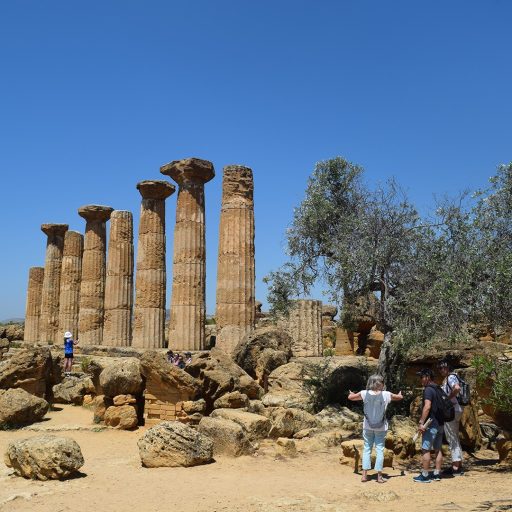
All of these twists and turns, and the twisters and turners who made them, have left lasting marks on Akragas’ cityscape. The richness of the Valley of the Temples shows just how well this city did from relatively quickly after its foundation in the early sixth century BC; it’s a relatively late arrival in the Greek colonisation phase, but perfectly sited in a fertile territory, with a bonus of mineral resources, and rapidly became a major power in Sicily. Temples are always an indicator of that, and the catwalk of grandiose examples of the sixth and fifth centuries is truly astonishing. One after the other – easily visible along the length of the ridge – these sandstone (but originally stuccoed, as normal in Sicily) structures march off into the distance, daring anyone to doubt Akragas’ brilliance.
Unlike some Sicilian temples, anonymised by time and cautiously labelled Temple A, B, C etc. by archaeologists, these, through being prominent early and visited by antiquarians and Grand Tourists were enthusiastically, romantically and almost entirely wrongly named. We have the Temple of Juno, of Concord, Mars and so on but mostly on highly questionable sometimes provably spurious, grounds. Still, they’ve had those names for centuries, so they’re part of the history too, now. There are far more than the obvious, large and preserved examples – smaller shrines dot the area, and there are more up by the ancient city centre and on the Acropolis, inevitably – given that this is Sicily, their home turf – several to Demeter and Persephone. A major series of shrines of the latter, accompanied by the special buildings necessary for her cult, probably women-only (as is normal, but Akragas seems to have done some things differently) take up a large sector at the far end of the Valley. As for the preserved temples, we don’t just owe those to good fortune, but to protectors, sometimes incidental ones. The Temple of Concord, for example, perhaps originally to the Dioscuri and of a roughly similar date to the Parthenon at Athens, owes its status as one of the best preserved in the Greek world, to being turned into a church by St Gregory of the Turnips in the sixth century (all part of a rather murky business, and having a necessary prelude in him driving out the ‘demons’ Eber and Raps to make use of the place. Slightly unjustly, St Gregory earnt himself the accolade of patron saint of archaeological protection by hijacking the building).
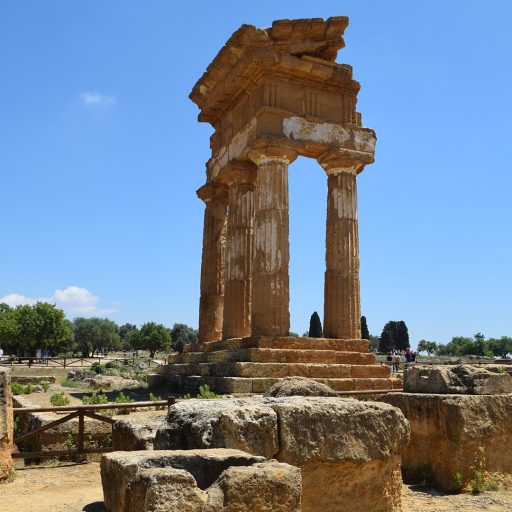
Further west, the so-called (rather than actual) Temple of Castor and Pollux, maintains a corner of its colonnade and architrave – except it doesn’t: these were thrown back up by antiquarians in 1836, as it turns out erroneously. But it looks magnificent, and is now an icon of the site, so there it stays. More truly counting as protection is the work to restore and recover several of the temples in the 1920s by an Englishman, Alexander Hardcastle, who came to the city and fell in love with it at a time when it was at a fairly low ebb. In restoring the ancient buildings to the appearance they have now, he not only spent huge amounts of his money in truly Akragantine fashion, but also benefitted the modern city hugely. He deserves our grateful thanks; all the more so because of the sad end of his story (but if you want to hear that, I’ll have to tell you standing before his house and portrait: hope to see you there!).
You’ll be thinking how magnificent all this sounds, and we’ve only scratched the surface so far. We’ve not touched on the splendid public buildings, the Oratory of Phalaris, the neat streets of Hellenistic and Roman houses, filled with superb mosaics to be seen in the excellent museum; we’ve not been to the Gymnasium and or admired its long bench with the ticker-tape inscription of its donor, or pondered the child’s sarcophagus of Roman times. Or…no, time to rein ourselves in. We can see all these things when we visit.
What we can’t miss out, though, even if briefly, is a mention of one of ancient Akragas’ most impressive constructions, a muscle-car of ancient temples, the massive Temple of Olympian Zeus. Today, it’s a heap of super-sized collapsed capitals, columns, bits of entablature and a vast base that you have to fully point out the limits of to unbelieving companions. The gargantuan flaring Doric capitals absolutely take you aback on first sight, and the scale of the altar – outside the temple, as normal in the Greek world – is almost beyond belief. Even in this state of tumble (it was much pilfered in later ages to build the harbour of Porto Empedocle nearby), it has lost none of its power to astonish. It was an unusual temple, as several in Sicily are, and the icing on the cake, another gasp-inducer at the museum and also impressively laid out on the ground by the temple, are the colossus-scale telamon statues, figures of giants, who bore on their impregnable shoulders the great weight of the shrine’s walls. It all begs you to reconstruct the original in your mind, truly a worthy home to cloud gathering Zeus. 
The Akragantines were a by-word for magnificence and opulence. As their own philosopher, Empedocles, would say: they dine as if they will die tomorrow, and build as if they will live forever. A mindset that the remains make truly believable. What a place!
To explore the extraordinary temples at Agrigento with expert guides, do please sign up for our Exploring Sicily tour.


Leave a Reply