

As we travel across the island we discover Crete’s distinct natural beauty: its sublime mountains which unfold their slopes across the island, transforming themselves into deep dramatic gorges and into vast fertile plains before reaching the Cretan blue waters. We also have the opportunity and pleasure to uncover many aspects of Crete’s living traditions, and this is what this post is about.

The view from where we stay in the south of Crete.
A voyage to Crete is like a ritual passage to the wild land of its generous inhabitants and their centuries-old traditions. It carries the folk sounds of local violins and bagpipes, the verses of the 16th and 17th centuries Cretan romances, the words of figures like ‘Zorba the Greek’ and ‘Captain Michalis’ shaped by the pen of the heretic literary giant Nikos Kazantzakis. It’s no surprise that the island’s cuisine makes use of a vast array of indigenous wild greens and vegetables and there are a whole host of traditional pies, trahanas dishes (cracked wheat mixed with fermented milk), local cheeses served with honey, and of course of a lot of meat, including the famous Cretan feral goat, known as ‘kri-kri’.

Here we share one of the most celebrated traditional Cretan dishes, Gamopilafo, made of goat meat and poultry with rice cooked in meat broth. Τhis is a dish that we love, full of the rich aromas of goat meat and goat butter. Not just any old risotto, this speciality warms our souls during the cold winter evenings when the wind whistles through the windows, and also embraces all our senses during summertime when it is shared with friends and the sound of music under the bright stars of the Cretan sky.
Its name means “wedding rice” and it is offered in many regions of this great island as the primary dish during the time of major religious festivals and of wedding feasts.
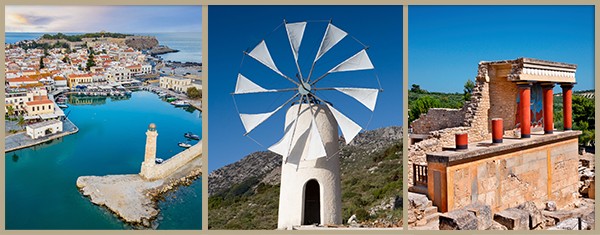
We regularly travel the length and breadth of Crete, this beautiful Greek island, offering our guests a comprehensive panorama of its extraordinary wealth in archaeological and historical sites, beautiful and diverse landscapes and rich culinary tradition. Days are spent exploring fascinating ruins, ancient structures, old town centres or traditional villages, walking through some of the island's many famous limestone gorges or on the flower-strewn flanks of hills and mountains, and of course enjoying Crete's produce in a seemingly endless string of tavernas and restaurants, as well as some wineries.
 The origins of Gamopilafo are unclear. According to a Greek version, it could be a survival from the time when the “Serenissima” the Republic of Venice, controlled much of the Aegean, including Crete from the 13th century onwards. However, the island's risotto-like dishes appear to be related to both occidental (risotto) and Anatolian (pilaf) cuisine. Thus, Gamopilafo might well be an amalgamation of Venetian and Eastern traditions, incorporating influences from the era of Turkish rule (17th to 19th centuries). In any case, the end result is neither occidental nor oriental, but distinctively Cretan. Thus, Gamopilafo is a perfect culinary representation of the long and complex history and also the strong local character of the island.
Nowadays, the Cretans, using local products – goats and lambs are abundant in the mountains of the island – have adopted their own way of preparation with many different local variations. It is a key feature at traditional weddings – as it emphasizes the hosting family's fertility and wealth by using rice, meat and poultry at the same time. Gamopilafo also makes an appearance at village feasts and many family celebrations.
The meat used in Gamopilafo is traditionally goat and rooster, but lamb and turkey or chicken can also be used as substitutes. The preparation we suggest takes about 3 hours in terms of cooking time. It is a simple and minimal recipe, avoiding the use of too many or overly complicated ingredients. Its flavour and taste rely especially on the high quality of the meat (fresh and local) and on the aroma of the butter used (traditionally home-made goat-milk butter).
Ingredients (serves: 8)

1 turkey or chicken (1 ½ kilo)
2 big cups of rice (as used for risotto – preferably the Arborio type)
2 tbsp of goat butter (if unavailable, use the best butter you can find)
½ cup of lemon juice
Salt and pepper
Preparation
Wash the meats well and boil them together for about 2 hours on low heat in a large pot or casserole dish with sufficient water to cover the meat throughout. Add 1 tablespoon of salt and pepper as well as some oil at the beginning*.

Strain the broth.
Plan ahead to have about three times as much liquid as rice.
Reduce the heat to medium; put the drained broth (6 cups) in the pot again. Pour in the rice (2 cups) and stir, to prevent the rice from sticking to the bottom of the pot. Stir constantly for about 15-20 minutes until the mixture has become even. Add ½ cup of lemon juice not long before the rice is cooked.

Put the rice in the serving dish along with the meat.
Your Gamopilafo is ready. Best eaten with a variety of other wonderful Cretan dishes, in Crete. Enjoy!
*According to another version, popular in some Aegean islands, you can add chopped green and red peppers and 1 tablespoon of tomato paste diluted with some water.


Leave a Reply