
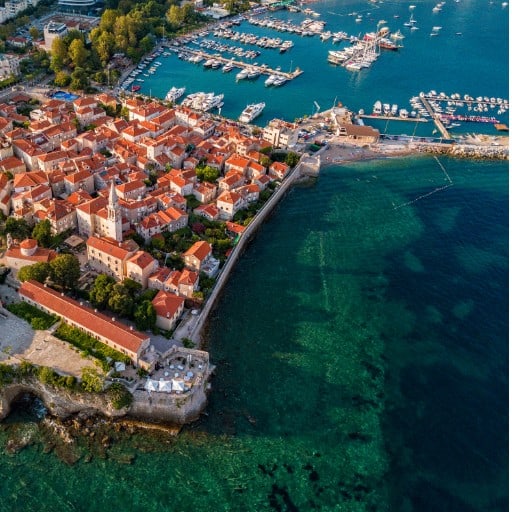
Aerial view of Budva's Old Town
The history of Budva, at least according to ancient Greek mythology, begins in Thebes with the hero Cadmus. Cadmus, the brother of Europa and the legendary founder of Thebes was exiled from his city after slaying a serpent sacred to Ares. Cadmus and his wife Harmonia wandered north to the Adriatic and eventually found refuge with a tribe called the Enchelei . At the time, the Encheleians were embroiled in conflicts with the Illyrians. With the legendary hero on their side, the Enchelei triumphed, and Cadmus became king of both the Encheleians and the Illyrians. He and Harmonia had a son named Illyrius, and Cadmus established a city on the Adriatic coast called Bouthoe – our Budva.
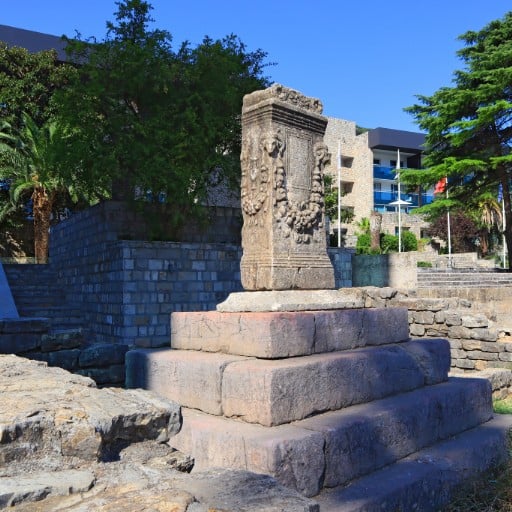
Excavations of the Roman Necropolis
Once we emerge from myth, we find the ancient Greek playwright Sophocles mentioning the city of Bouthoe in the fifth century BC, followed in the next century by the Periplus of Pseudo-Scylax, a guide describing coastal landmarks and trade routes in the Mediterranean and Black Seas. This document, believed to have originated in Athens, includes references to Greek colonies and trading posts along the Adriatic coast, lending some historical credibility to the geographical significance of the area. Other evidence suggests Athenian interest and activity in the area in the same period.
Similarly, the Illyrians—named in numerous historical texts—were real people behind the myth. Their origins can be traced back to the Bronze Age population of the eastern Adriatic coast around 1300 BC. Over time, they developed into numerous small tribal groups, stretching from the northern shores of the Adriatic and the Istrian Peninsula in present-day Croatia to the southern regions of Albania. They could also be found inland, in Bosnia and Herzegovina, reaching deep into the heart of the Balkan Peninsula.
The Illyrians lived in rural settlements, usually on the edges of arable fields. They are best known for constructing their hillforts on mountaintops that served as defensive structures and watchtowers. These ancient strongholds were places of refuge during times of conflict, particularly in their numerous clashes with the Romans. One such hillfort still stands proudly above Risan in the bay of Kotor. Alongside the hillforts, their cairns are the most notable feature still visible in the landscape today. In cairns, Illyrian chieftains and kings were buried alongside weapons and jewellery, symbols of their power and status.
By 9 AD, the Illyrians were conquered by the Romans and, over time, became Romanized—gradually adopting Roman identity as their own. Within a few centuries, they became indistinguishable from other Roman citizens. However, their name and the myths surrounding them endured. William Shakespeare used Illyria as a fictional backdrop in Twelfth Night, and after defeating the Austrians, Napoleon named his newly acquired provinces along the Adriatic coast the Illyrian Provinces.
How far does this match the archaeology? The evidence beneath the streets of Budva's old town and its sprawling necropolis suggests that ancient Bouthoe was initially an Illyrian settlement. In the 4th century BC, a Greek trading post, or emporium, was integrated into the settlement. Its necropolis, the burial ground, located just outside Budva's old town walls, contains graves all the way from the fourth century BC through to the fifth century AD, demonstrating the town's continuous habitation for over a thousand years. These findings also highlight the arrival of Roman settlers, whose presence we need to account for.
To do this we have to recall the days of Illyrian might in the fourth and third centuries BC. By this time, as a result of their activities as great raiders by land and sea, they had built a kingdom: one which came into bruising contact with the Roman republic in the 200s BC. In the name of suppressing Illyrian piratical outrages, the Romans undertook one of their first forays outside Italy. By 168 BC, after a prolonged series of conflicts, the Romans decisively defeated the Illyrian kingdom and established the province of Illyricum. Just over a century later, a certain Gaius Julius Caesar held the proconsulship (in this case meaning ‘governor’) of Illyricum.
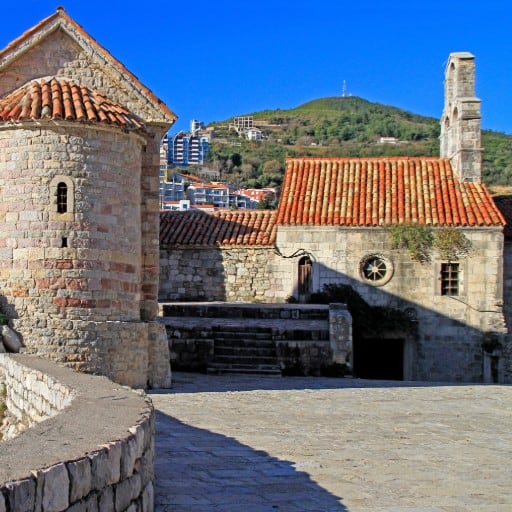
The Church of Santa Marija in Punta
By the first century AD, historical sources refer to the settlement of Budva as an oppidum civium Romanorum, meaning the inhabitants had the privilege of Roman citizenship, even if at a less exalted level than a full colony. Later we find its Roman name, Butua. Numerous Roman artefacts unearthed in Budva well attest to its integration into the Roman Empire.
Budva became a bishopric during the Middle Ages, with a diocese established in 743. Remnants of a late antique basilica in the heart of the old town underscore its religious and historical significance. The Church of St. Mary in Punta, built in 840, is one of the oldest churches dedicated to the Virgin Mary on the eastern Adriatic coast.
We hear a bit about Budva's history - primarily from written records - between the 9th and 15th centuries. It was part of Byzantine Dalmatia and later – the Illyrians having long vanished from history - came under the rule of the Slav princes of Duklja, Raška (Doclea and Rascia to the Byzantines), and Zeta. Budva gained autonomy and a charter during the Serbian Nemanjic royal dynasty's reign in the 12th century. The unification of Zeta with Raška from 1185 to 1361 led to the spread of Orthodox Christianity in Budva, prompting Pope Clement VI to demand the return of Catholic properties in 1346.
Visitors to this fantastic coast will know of the beautiful Venetian aspect of some of its medieval towns. Budva entered the Serene Republic’s dominion in 1442. Like other Venetian cities in the eastern Mediterranean, it was governed by a Venetian-appointed provveditore (overseer). A Great Council (Maggior Consiglio), modelled after Venice's own, was established as the chief political assembly responsible for electing other offices in the town. By this point, though, the world was changing. Byzantium was about to fall to the Ottomans, and Venice would have a harder world to navigate.
In the summer of 1571, the Ottoman fleet pillaged and burned cities along the Adriatic coast. Some towns, like Korčula, managed to repel the invaders, but Budva was heavily damaged. Later that year, the Holy Christian League fleet achieved a decisive victory against the Ottoman navy at the Battle of Lepanto, a turning point commemorated with relics preserved in many Adriatic towns, including Budva. The city would then remain in Venice’s hands.
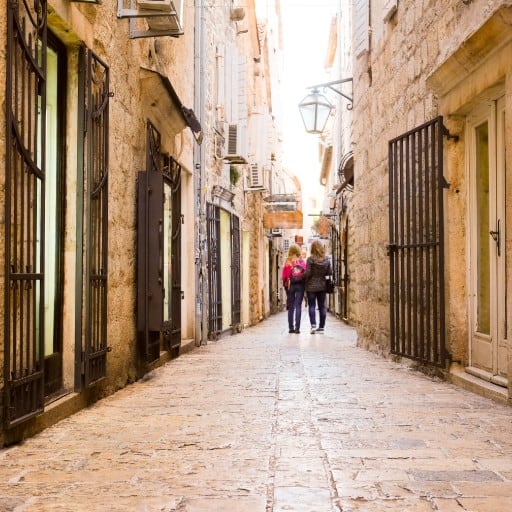
Cobblestone streets of Budva’s Old Town
During the Napoleonic Wars, Budva experienced further political turbulence. Following the fall of the Republic of Venice in 1797, the town came under Austrian, Russian, and then French control. The latter was shortlived. After Napoleon's defeat in 1814, Budva returned to Austrian rule and remained under Habsburg control for a century.
Following World War I and the dissolution of the Austro-Hungarian Empire, Budva joined the Kingdom of the Serbs, Croats, and Slovenes (which became the Kingdom of Yugoslavia) in 1918. During World War II, it was occupied first by Italy in 1941 and then Germany in 1943. The local population played a significant role in the Partisan resistance movement, with over 200 losing their lives. After the ruin of war, in Tito's Yugoslavia, tourism became a driving economic force and aid to recovery, supported by significant infrastructure improvements.
Budva certainly had a part to play in all this and must have received a certain economic boost and gleaned some reflected prestige from a little island just across the bay. For visible from its mighty defences lies one of the most iconic symbols of tourism in Montenegro, the island resort of Sveti Stefan, which in the middle of the 20th century became a hotspot hotel isle, frequented by the rich and famous.

The island of Sveti Stefan
Today, the old town of Budva is a beautiful and well-preserved historical landmark. Its impressive surrounding fortification walls form a nearly complete unit, separate from the modern city of Budva that has grown up alongside. A charming maze of stone-paved streets winds through these ancient walls, occasionally opening into small squares filled with lively cafés and restaurants. As we wander these narrow streets, we can discover stunning medieval churches whose architecture evokes the times of the old Byzantine capital of Constantinople. A beautiful Venetian palazzo still stands, showcasing a unique blend of Eastern and Western influences.

View from the Budva Town Museum
If you climb to the town citadel or stroll along a section of the city walls, you'll be treated to lovely views of the small island of Saint Nicholas in the bay of Budva. Tucked away among the winding streets is the vault of Budva's ancient history—the town museum. Here, we can explore old inscriptions, mosaics, and other artifacts that recount the stories of Budva's past. Every house and every narrow lane in the Old Town tell a different story—tales of ancient Greek traders, Roman conquerors, medieval Montenegrin nobles, Venetian merchants, and Napoleon's soldiers. From the remains of the Roman baths to the late Roman basilica, preserved as an archaeological site, and some of the oldest medieval churches on the Adriatic coast, everything you can see here speaks to the rich history of the town and the whole country.
You can explore Budva and many of the other historical gems along this magnificent coast, with archaeologist expert guides, on our gulet cruise in Montenegro.

Gradenigo Tower, Old Town fortifications


Leave a Reply