

Although less well known than larger towns on the Croatian coast, such as Dubrovnik or Split, the small town of Ston has a quiet charm that captivates visitors at first sight. Situated just under sixty kilometres northwest of Dubrovnik, Ston is a place in southern Dalmatia where history and gastronomy intertwine in fascinating ways. On the one hand, Ston reveals a wealth of intriguing historical narratives. On the other, it is widely celebrated for its remarkable culinary heritage. The town has long been renowned for its centuries-old salt production and shellfish farming, as well as for its many regional delicacies. Before turning to some of the gastronomic specialities that have made Ston famous, it is worth briefly exploring the town’s past, because its history is deeply intertwined with the culinary traditions that define it today.
ANCIENT AND MEDIEVAL HISTORY OF THE STON REGION
Ston’s geographical position is essential to understanding its development. The town lies on the coast of the Ston Channel and close to the narrow isthmus connecting the long Pelješac Peninsula with the mainland. Such a strategic location encouraged early settlement. Archaeological evidence suggests human presence as early as the Neolithic period (c. 6000 – 3000 BCE). Traces of the earliest communities have been discovered in caves above the fertile Ston plain that dominates the landscape around the town. More intensive habitation is recorded from the Iron Age (c. 900 – 100 BCE) onwards. On the elevated terrain along the edge of the plain, hillfort settlements were established, typical defensive positions for communities living along the eastern Adriatic coast during this period.
During Roman rule, settlement gradually moved from the hills down into the lowland area. This shift was likely motivated by two key factors: the desire to control the fertile agricultural plain and the advantages offered by the shallow coastal bay, which was highly suitable for salt production. Indeed, it appears that the Romans may also have given the town its name. The name Ston likely derives from the Latin stagnum or stamnum, terms referring to stagnant or still water. The name indirectly suggests that the area may already have been used for salt production in Roman times. The Romans also exploited the fertile plain through centuriation, the characteristic Roman system of land division.
By Late Antiquity, Ston had become the seat of a bishop, clearly attested in early medieval written sources. During the early Middle Ages (7th – 11th c. AD), the town fell under the authority of various Slavic rulers who gravitated to the broader Croatian cultural sphere. In the twelfth century, Ston came under the control of the medieval Serbian state ruled by the Nemanjić dynasty. What followed was a period of frequent political change, during which local counts, Croatian and Serbian nobles, as well as Bosnian magnates alternated in their rule over the region.

A fresco depicting one of the Slavic kings in the Church of Saint Michael near Ston (source: Pinterest).
A new and decisive chapter in the history of Ston began in 1333, when the Republic of Dubrovnik, also known as the Republic of Ragusa, purchased the territories of Ston and Pelješac from the Serbian Emperor Dušan the Mighty. With this transaction, a new era began for this small yet historically significant Dalmatian town.
STON IN A NEW URBANISTIC FORM: UNDER THE AUTHORITY OF THE DUBROVNIK REPUBLIC
After coming under the rule of the Dubrovnik Republic, during the fourteenth century Ston underwent a profound urban transformation. Dubrovnik invested heavily in the development of the town and reshaped it according to a carefully planned urban concept. Streets were arranged in a regular orthogonal grid, while numerous Gothic and Renaissance buildings were constructed. One of the most pressing concerns for both Ston and the Dubrovnik Republic was the protection of the saltworks located in the area, as well as the wider territory of the Pelješac Peninsula. Their economic importance was considerable: salt production represented a major source of wealth, while the peninsula itself was well suited to vineyards and agriculture.

Ston, a medieval town laid out in a regular orthogonal grid.
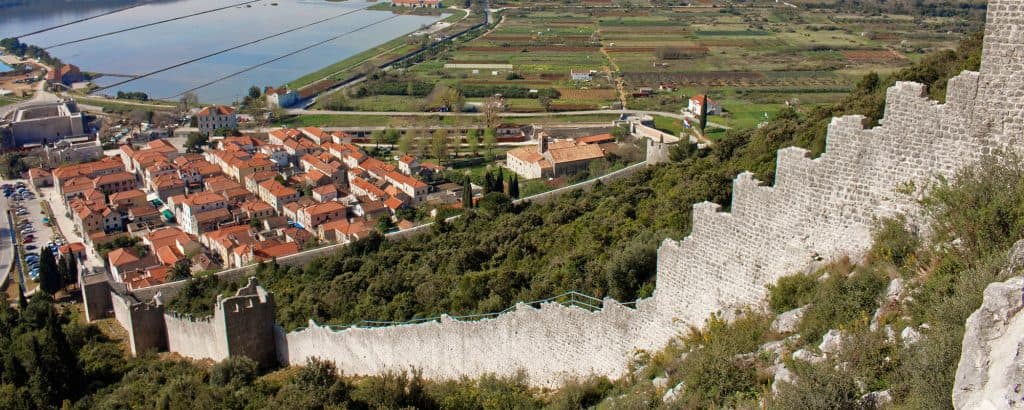
To safeguard these resources, the authorities of Dubrovnik constructed an extensive defensive wall system connecting Ston, on the Ston Channel, with Mali Ston (“Small Ston”), on the Mali Ston Bay. In doing so, they effectively controlled access to the Pelješac Peninsula. The walls were built over a period of roughly thirty years and rank among the longest medieval fortification systems in Europe. Originally stretching for about seven kilometres, they linked powerful fortresses, situated in Ston and Mali Ston. The defensive complex was further strengthened with more than forty towers and semi-circular bastions, while the fortifications were repeatedly expanded in later centuries. Construction and reinforcement of the system continued for nearly four hundred years, and the walls remained in defensive use until the early nineteenth century.

Today, a significant portion of this impressive fortification network has been restored and is open to visitors. When travelling towards the historic salt pans or the nearby town of Mali Ston, renowned as the centre of regional shellfish farming, the sweeping stone walls form one of the most striking sights along the route, immediately capturing the attention of every traveller passing through this remarkable landscape.
SALT FROM STON – A PRECIOUS RESOURCE
Ston Saltworks are one of the three major salt-producing complexes in Croatia. Their present form dates back to the fourteenth century, when they were put into operation by the Dubrovnik Republic. From the very beginning, the saltworks proved to be an extraordinary economic asset. In the Middle Ages and the early modern period, salt was an exceptionally valuable commodity, often referred to as “white gold.” The production and trade of salt played a crucial role in strengthening the prosperity and political power of Dubrovnik, today one of the most celebrated historic cities on the Adriatic coast. Historical records indicate that they generated an annual income of around 15,900 gold ducats, equivalent to roughly 56 kilograms of pure gold.

A historic postcard from Ston depicting the salt pans (source: neodoljivahrvatska.eu).
From its earliest days, the Ston saltworks were carefully organised into a system of basins that remains largely unchanged today. The method of production has endured for centuries with minimal alteration. Seawater is gradually channelled through a sequence of shallow pools. As the gates between the basins are closed, the water slowly evaporates under the combined influence of sun and wind. Through this natural process, salt crystals eventually form on the basin floors.
The harvesting season takes place during the warmer months, typically from April until October. Each year, approximately 500 tonnes of salt are collected from nine crystallisation basins. Once harvested, the salt is transported in traditional wooden wagons, which can still be seen today near the interpretative centre of the saltworks. The salt is then stored in large historic warehouses, structures that visitors often have the opportunity to explore during guided tours of the site.

The salt harvest in Ston (source: neodoljivahrvatska.eu).
Altogether, the Ston saltworks consist of 58 basins, arranged into five groups corresponding to the five stages of the crystallisation process. Many of these basins bear the names of Christian saints. Among them, the most notable is the one named after St Blaise (Vlaho in Croatia), the patron saint of the Dubrovnik Republic. Another especially valued basin was Lazarus (Lazar in Croatian), which, like Vlaho, was regarded as a source of exceptionally high-quality salt. Under the rule of Dubrovnik, several of the most prized basins, including Vlaho and Lazar, had granite-lined floors. This made it possible to obtain particularly pure salt, which was reserved for export to prestigious markets, among them the imperial court in Vienna. One basin, however, bore the intriguing name Mundo, which stands apart from the predominantly saintly names of the others. Translated from Latin, its name means “to the world,” suggesting a broader civic purpose. In the early modern period, the salt harvested from this basin was intended specifically for the ordinary citizens of the Republic.
A LONG TRADITION OF SHELLFISH FARMING IN MALI STON BAY

Another important natural resource of the Ston region is its shellfish. Evidence of shellfish exploitation in the waters of Mali Ston Bay dates back to the period of Roman rule, although the first written records referring to the harvesting of shellfish appear in the sixteenth century. Systematic cultivation, however, is documented from the seventeenth century onwards. The organisation of shellfish farming was carefully regulated by the Dubrovnik Republic, which introduced a system of concessions and privileges granted to local cultivators. Through this system, shellfish farming gradually developed into an important economic activity in the area around Mali Ston. Its bay is particularly favourable due to the mixing of nutrient-rich freshwater from the Neretva River with the clean waters of the Adriatic, as well as suitable seabed and depth.
Traditionally, two principal species are cultivated in the bay: the European flat oyster (Ostrea edulis) and the Mediterranean mussel (Mytilus galloprovincialis). Both remain among the most recognisable gastronomic symbols of the Ston region.

Oysters and mussels – crucial staples of the Ston region’s cuisine.
A significant expansion of the shellfish industry occurred in the early twentieth century. One particularly notable moment came in 1936, when local producers were awarded a gold medal at the World Exhibition in London for the exceptional quality of Ston oysters, the type of shellfish for which the region remains widely renowned today.
The European flat oyster typically grows to about 13 centimetres and lives attached to hard substrates, usually forming relatively sparse colonies. These shellfish feed on plankton and are hermaphroditic organisms that reproduce mainly in May and September. Oysters may be collected from natural populations, but they are also deliberately cultivated. The traditional cultivation process is divided into three principal stages: (1) the capture and cultivation of young oysters, (2) the preparation of bundles into braided strings, and (3) the final stage in which oysters are cemented onto ropes for further growth.
Historically, oyster farmers used bundles of tree branches to collect young oysters. Today, these natural bundles have largely been replaced by plastic mesh collectors, which are more durable, inexpensive and reusable. Collectors placed in the sea in April are typically removed between September and October, while those installed in September are usually retrieved from April to June of the following year. At this stage the young oysters measure between 8 and 20 millimetres. Once removed from the sea, the bundles are cut into segments of approximately 20 centimetres. The young oysters are distributed evenly so that each segment carries roughly 10 to 15 individuals. These prepared segments are then suspended in the water at a depth of about half a metre below the surface. Care must be taken to ensure that they do not touch the seabed, as sediment and marine pests could damage the oysters.

By the end of the second cultivation stage, when the oysters are 12 to 18 months old, they reach a size of around 4 centimetres and are ready for the next step, known as cementing. The most favourable period for cementing begins in early June. At this stage the oysters are removed from the ropes, washed and sorted according to size. Smaller, malformed or underdeveloped specimens are discarded. Medium and larger oysters are temporarily kept in baskets in the sea, and the cementing process must be completed within three days, otherwise the oysters may die. Cement is used as an adhesive to attach the oysters in pairs at the ends of rope. After this stage, an additional six to twelve months are required before they are ready for harvesting. In total, the cultivation cycle typically lasts up to three years, although market size, about 7 centimetres, is usually reached after two years. The oysters are then harvested, cleaned and prepared for distribution to markets and restaurants, where they continue to represent one of the most prized delicacies of the Adriatic coast.
By the late 1980s, shellfish farming in Mali Ston Bay had reached an exceptionally high level, with around 1.5 million oysters and between 2,000 and 3,000 tonnes of mussels produced annually. This development was briefly interrupted at the beginning of the Croatian War of Independence (1991 – 1995), but following the establishment of Croatian independence the shellfish industry gradually began to recover and develop again. It is estimated that today Mali Ston Bay produces between one and two million oysters annually, depending on favourable or less favourable production years.
In Croatian restaurants, oysters are prepared in a variety of ways. They may constitute the main element in special soups, be lightly battered and fried, baked, or grilled, among other culinary variations. Many gourmets would suggest that the finest way to enjoy oysters is also the simplest: freshly opened and lightly seasoned with a squeeze of lemon juice. The experience we have at Ston on our Gastronomic gulet cruise allows you to enjoy them exactly in this way.

Oysters being prepared for tasting.
AN UNUSUAL DESERT – STON CAKE
Ston is also known for a rather unusual dessert: the famous Ston Cake (Stonska torta). This traditional delicacy also has history, dating back to the time of the Dubrovnik Republic. It is a distinctive festive cake made from sweet yeast dough or pasta dough, filled with macaroni and a rich mixture of ground walnuts and almonds, chocolate, butter, eggs, sugar, citrus peel and spices (especially cinnamon). Baked in a round shape, the cake is typically prepared for special occasions, such as the Feast of Saint Blaise (3rd of February) and other local celebrations, making it one of the most unique historical desserts of the Dubrovnik region.

Ston cake (source: https://tzdubrovnik.hr/).
A UNIQUE GASTRONOMIC EXPERIENCE
Ston and Mali Ston are among the most distinctive places in Dalmatia, where history and gastronomy come together in a remarkable way. Visitors have been drawn to the region’s cuisine, particularly seafood dishes seasoned with the renowned Ston sea salt. Especially notable are oysters cultivated in Ston's unique waters creating conditions that give these delicacies their exceptional quality. This maritime gastronomy is further complemented by excellent wines produced from vineyards on the Pelješac Peninsula, one of the most celebrated wine-growing regions in Croatia. The combination of fresh seafood, local salt, and distinguished Pelješac wines creates a culinary experience that reflects both the natural environment and the long cultural traditions of the region. For anyone interested in the cultural and culinary heritage of the Adriatic, Ston remains an essential and memorable stop.

The streets of Ston today.
You can explore Ston and Mali Ston with one of our expert guides on our Gastronomic Gulet Cruise in Croatia.


Leave a Reply