
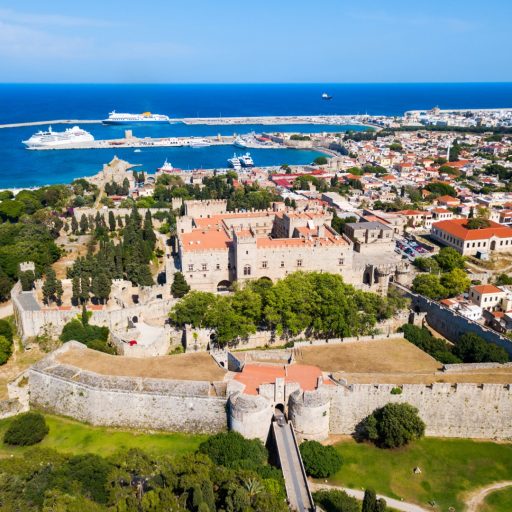
A view over the northern part of Rhodes, with the fourteenth century Palace of the Grand Masters at centre. The sixteenth century fortifications are in the foreground: notice just how thick the walls are, and how wide the ditch in front of them is. Behind is Rhodes’ great harbour. On the central mole, just right of the cruise ship, is the Tower of the Windmills, built in the 1440s-50s but badly battered by Ottoman artillery in 1480.
Rhodes now is a place of sun-bleached streets, t-shirted visitors ambling past brightly-painted houses thinking glad thoughts, rightly congratulating themselves they made the decision to come to a place that’s already wildly exceeding their expectations. Everywhere there’s verdant greenery, shading trees and cresting waves of purple bougainvillea breaking over the honey-coloured stone.
At this point there’s a danger of saying something like “this charming modern exterior hides a darker past,” but we’d never be so trite. Not directly, anyway, and fortunately for your time here, there’s no hiding involved, just the need for a storyteller to bring it to life. Because everywhere in the old town, Rhodes’ medieval past is visible, and street by street the Knights of the Hospital of St John of Jerusalem proclaim their role in the city’s making. From the time they seized the city in the early fourteenth century until their expulsion by perhaps the greatest Ottoman ruler amid the roar of cannon-fire and the clash of sword and armour, the Hospitallers made Rhodes as we know it today, and left us extraordinary events to retell.
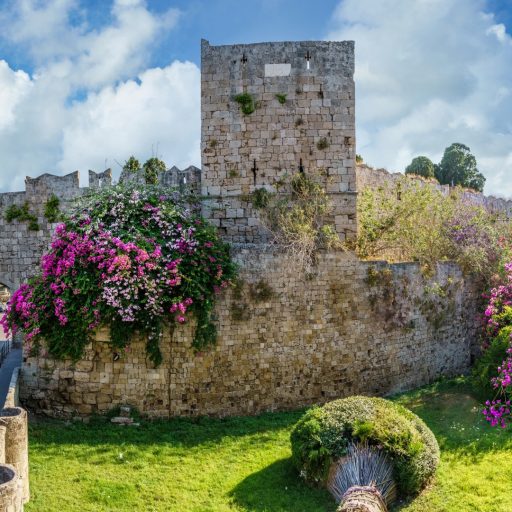
A tower near the Tower and Gate of St Paul in the north of the city. It’s one of the oldest in the fortifications, as you can see by its height and angularity – it’s less well adapted to resist artillery. It dates to the 1370s. The ‘swallow-tail’ merlons (the standing part of the battlements) are a typical feature of Rhodes’ walls.
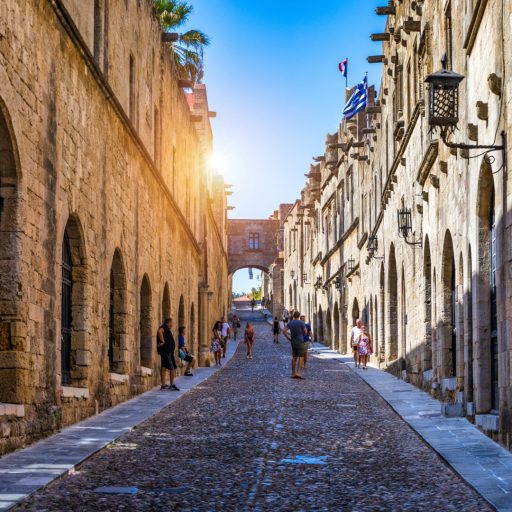
The Street of the Knights, dating to the fifteenth-early sixteenth centuries. The Inn of France is visible to the right, crowned by turrets and with the tricolore flying above.
Most, in thinking of Rhodes and the Knights, will have in mind the grand inns, the auberges, of the Steet of the Knights, drawn back to the fifteenth and early sixteenth centuries, the eye tracing upward past its characteristic black lanterns and tall, impressive facades housing the gathering places of this martial brotherhood and its ‘langues’ of lands and powers alternately faded and familiar. Some might follow the street to its ending and come to the great Palace, literally towering over the city, still proudly asserting the absolute authority of the Grand Master of the Order with its machicolated drum turrets, spacious courtyards and stern, lofty walls. That’s only natural: these are places that inspire anyone who comes to them. But for the most extraordinary stories of the Rhodes of the Knights, it’s worth turning to the more utilitarian architecture of the city’s walls, once a place of rubble, constantly-changing fortunes and desperate bravery.
The Hospitallers of course came here after the fall of the Crusader states in the east, where they had their origin. Determined to continue their role as warriors for, and protectors of, the Faith, they inserted themselves into the forefront of the contest, where Turkish ghazi warriors were doing very much the same thing. And here they remained, ruling an archipelago-state in the Dodecanese at the vanguard of the incessant conflicts of the fourteenth to sixteenth centuries, a period so bloody and eventful that one wonders how an ordinary life could ever be lived within it. As it wore on, the Ottoman Turks became ever more clearly the victors, and the Knights came into an ever more exposed, ever more isolated position, one that resulted in two of the most dramatic, hard-fought sieges in history and one which has left us some of the most magnificent defensive walls in the Mediterranean.
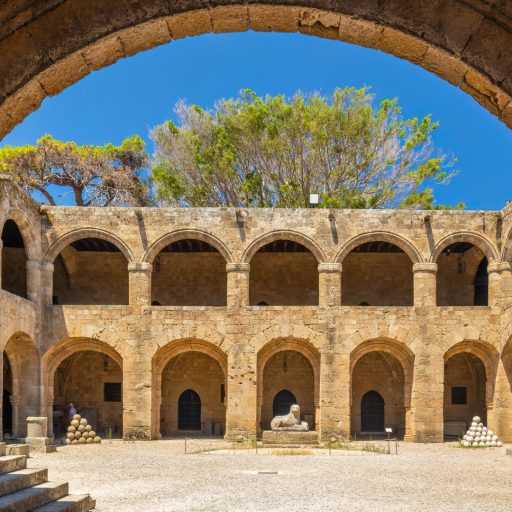
The courtyard of the Archaeological Museum, once the Hospital of the Knights of St John and built by Grand Master Antonio Fluvia (1421-1437). It was badly damaged both in the siege of 1480 and World War 2.
In the first siege (there were in fact others, but we’ll restrict ourselves to the two most famous), the Ottomans landed a typically vast force and threw themselves at the already strong fortifications for weeks, from May to August of 1480. Battering cannon made vast breaches, assaulted by huge forces to the fanfare of drum and trumpet, and ultimately beneath the black flag that signified No Quarter. Reading about both sieges is exhausting even from the comfort and safety of a book’s covers as the Turks come so close to triumph, only for an unbelievable resistance, or the efforts of the Grand Master himself, to throw them back. At the end of any account of 1480, as you put the book down, you can almost hear the panting and exhaustion; feel the elation as the besieging fleet makes its departure.
It’s at this point that Rhodes is particularly interesting for the student of fortifications, for the Knights knew how close-run a thing it had been, and how close they had come to disaster. And here they stood with mutilated walls, stones spilling across the ditches without, certain that that Grand Turk’s men would come again. In a world where the Ottomans were masters of huge siege cannon, an update was necessary.
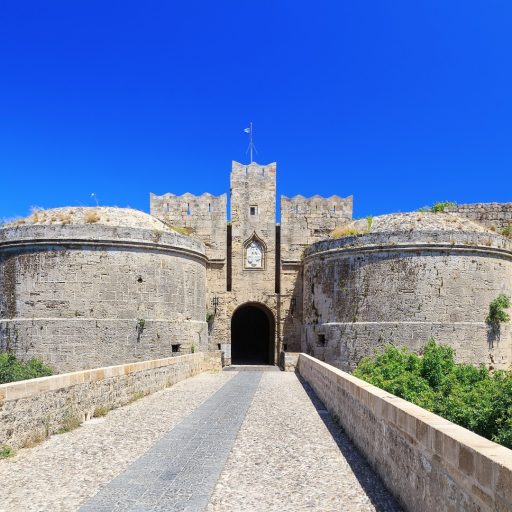
The D’Amboise Gate, the work of Grand Master Emery d’Amboise (1503-1512), and part of a major strengthening of this sector of the walls. Note the squat drum towers. Over the portal is a marble plaque depicting an angel holding the coat of arms of the Order of d’Amboise accompanied by the words DAMBOYSE MDXII, telling us the work belongs to the last year of the Grand Master’s reign. The vertical slits either side indicate the former position of a drawbridge.
There’s a danger of getting dry and technical here – and the technical details of bretèches and tenailles, barbicans and counterscarps are interesting. What makes them live – as so often when talking of siege warfare – is seeing the competing minds and aims at work. Seeing how new methods are brought in, new layers of defence to seal the weaknesses, to give hope and time to those within. And so – over the lifetime of safety that the defenders of 1480 bought – you see everywhere around the city the girdling line of walls puts on muscle. Deep, broad ditches push the attackers away and make it harder for their guns to strike the walls, artillery towers and forts – some of them surprisingly familiar to British viewers who've seen those of Henry VIII – appear and new, extra layers of stone armour the city, all clad with the arms of the knights and Grand Masters, and images of the saints, the surest protection.
As a result, when the host of Suleiman the Magnificent landed in 1522, the task they had to face was all the more difficult. It’s worth thinking about what all that defensive science, all the structures, meant for them. The charge towards landward walls their artillery could not easily get at to break, which were in any case now so much thicker and able to bear the weight of the cannonballs we can still see embedded in them or scattered across the floors of the ditches. And to get to those hidden walls, you need to descend the vertical face of that huge, broad ditch, the face of them now rising colossally above you as you reach the bottom. In the depths of the ditch, you’re shot at from ramparts and towers, or from the gun embrasures in their bases which sweep the level space between which you have to cross. Firearms, blades and glass grenades, mines and bombardment – everything that makes a siege so uniquely terrifying and hard-fought – decides the back-and-forth of what follows.
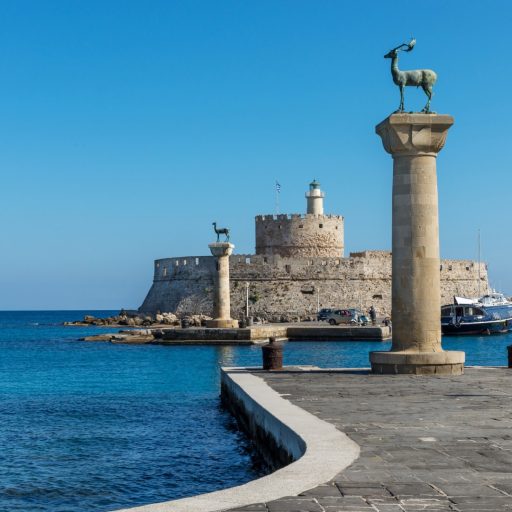
The outer entrance to Rhodes’ harbour. On the far mole is the St Nicholas Fortress which began as a relatively simple tower in the 1460s. Badly damaged in the great siege of 1480, it was surrounded by the slanting walls of the visible artillery outwork by Grand Master Pierre d’Aubusson (1476-1503), making it a key point in the defence. It was again severely battered in the 1522 siege. D’Aubusson himself was very nearly killed in the 1480 siege, severely wounded while leading a ferocious counter-attack at the Tower of Italy. Aged 57, and already wounded by an arrow in the hip, he was wounded another four times, including by a janissary’s spear which punctured his lung. Understandably, he devoted much of his reign as Grand Master to improving the defences.
For the Anglophone reader, the epic of the struggle for the English Post (in fact also drawn from Scotland and Ireland) is spine tingling. Enormous mines detonate, bringing down stretches of the wall; fathomless bravery sees the attackers force their way across the hellish interval and plant their banners in the rubble, only to be thrown back by an equally heroic counter-attack. And so, it goes on through September and October until the English langue is effectively wiped out in the city’s defence. This is one of the epicentres, but other stories are written in smoke and horror elsewhere on the line.
For more on them, though, you’ll have to see it with us in person. In the end, numbers tell, but heroism is recognised, and the Knights are able to withdraw – to perform similar deeds with greater success another lifetime later in Malta. For Rhodes, the next few centuries saw a secure Ottoman dominion that had little need of doing anything to the old fortifications rather than repair them and then leave them to grow old in their stories, so that we can pass on what’s written in the stones.
To visit Rhodes with expert guides, join our cultural and archaeological tour Cruising the Dodecanese


Is there a tour which would allow 4 days or more in Rhodes. Then Alexandria and Malta?
Hi Mary, unfortunately, we don’t have any such trips. We do have a trip that visits Rhodes, our Cruising the Dodecanese but we don’t currently visit Alexandria and Malta. Do please let us know if you have any questions about our trips. We will be delighted to help.