

Few places capture the spirit of the Adriatic as vividly as Montenegro’s Bay of Kotor. Towering mountains plunge into deep blue waters once navigated by Illyrian pirates, Venetian merchants, and Austrian admirals. To explore this bay is to sail through a crossroads of East and West, where Illyrian, Roman, Byzantine, and Ottoman legacies converge. Today, its walled towns offer not just a scenic escape, but a journey through two thousand years of Mediterranean civilisation. This is the heart of our gulet cruise itineraries in Montenegro - voyages through time and landscape.

Walled city of Kotor.
The name of the Bay of Kotor in Montenegrin, Boka Kotorska, derives from the Italian bocca (mouth) and Kotorska (of Kotor) - literally, “the mouth of Kotor.” Locals still refer to it simply as Boka, and proudly call themselves Bokelji, people of the Bay. This name likely reflects the legacy of Venetian rule, which lasted nearly 400 years and hints at the region’s layered history. Its strategic position within this winding, well-protected bay has always been key to its prominence.
At the southeastern tip of the bay stands the town of Kotor itself. Positioned on a narrow strip of land that forms a neat triangular shape when viewed from above, Kotor is still defined by its elegant stone houses, tightly nestled within a network of fortification walls and towers. High above the town, some 250 metres above sea level, the Fortress of St John watches not only over Kotor but also across the surrounding bay.
Looking upon the town as it clings to the lower slopes of Mount Lovćen, one is struck by the sheer amount of time, planning, and effort required by the master builders of the past to construct such an elaborate system of fortifications. Their ingenuity is especially evident on the northern edge of the walls, where the small river Škurda runs directly beneath, forming a natural moat and a second line of defence. Though the river is only a few hundred metres long, it has served to protect the town since its earliest days.

12th-century Church of St. Luke.
Archaeological and historical evidence suggests that the area around Kotor was settled well before the Roman conquest of the eastern Adriatic. The first named inhabitants were the Illyrians, the Indigenous Iron Age people of this region. They were farmers and seafarers - or as classical writers sometimes portrayed them with a hint of hypocrisy - pirates and raiders.
Kotor became a Roman town following the Illyrian Wars, fought between 229 and 168 BCE along the Adriatic coasts and in the rugged hills of the interior. These campaigns marked one of Rome’s first forays beyond Italy. Rome’s victory led to the Adriatic coast being absorbed into the rapidly expanding Republic, bringing it face-to-face with Macedonia and opening a path to empire in the East. This region played a pivotal role in the unfolding of empire. Despite the violent subjection, the town - known as Acruvium - settled into a lengthy period of relative peace, reflected in the growth of rich villas nearby, floored with charming black-and-white mosaics, all surrounded by the deep blue waters of the Adriatic and towering walls of rock.
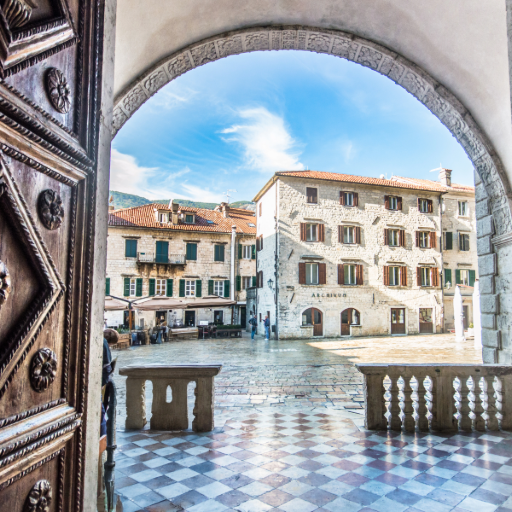
Cathedral Square of Saint Tryphon.
We can trace Kotor’s continuous history from Roman times through the fall of the Western Roman Empire in the fifth century AD. Amid the chaos of the collapse, in which events in this area played no small part, it became a refuge and stronghold for the remaining Romans - those who, following the Christianisation of the Empire, came to be known as Byzantines.
Adriatic history never remains static. Over the next 900 years, the town changed hands multiple times, and so did its name. Acruvium evolved into Catarum, Decadaron, Dekatera, Cathera, and finally Cathara - each echoing the modern name, Kotor.
In the sixth century, Emperor Justinian I (527-565 AD) ordered the first major fortifications of Kotor as part of his ambitious campaign to reconquer the lost western provinces. These defences were built to repel the Ostrogoths, a powerful Germanic kingdom that stretched from southern France to the eastern Adriatic. The walls would later serve against other invaders, becoming a lasting symbol of imperial resilience.

Square of Arms and the 17th-century Clock Tower.
With the passing of centuries, Kotor emerged in the medieval period as an autonomous commune governed by its own local prince - a powerful fortified fiefdom. Its excellent strategic position made this autonomy possible but also made it an attractive target for neighbouring powers. Until 1185, authority over the town shifted between the Byzantine Empire, governed from Constantinople, and local rulers from the region of Zeta, on the shores of Lake Skadar, as they expanded coastwards.
Later, Kotor enjoyed full autonomy under the Serbian Nemanjić dynasty (1186-1371), then the Hungarian-Croatian Crown (1371-1384), and finally the Bosnian kings (1384-1391). After a brief period of independence (1391-1420), during which it resisted attacks from powerful local feudal lords, the town voluntarily submitted - possibly with some relief - to the Republic of Venice. It would remain under Venetian rule for more than 300 years, until the final fall of the Venetian Republic in 1797.

Pima family palazzo from the 17th century.
Physical traces of these long centuries are still visible in Kotor’s fortifications, on the façades of its Gothic palaces and townhouses, and in its public buildings. Take a look at the fine but spare lines and sturdy build of the Palata Bizanti, then turn to the ornate pilasters and richly carved tympanum of the Palata Beskuća to see those centuries etched into the city’s stones. Remarkably, much of the old town remains preserved. Many buildings were damaged in a catastrophic earthquake in 1667, but the town was rebuilt and remained the most important port in the Bay of Kotor.

14th-century Church of Saint Michael, and lapidarium.
A particularly rich record of Kotor’s early history is preserved in the Church of St Michael. Originally constructed in the late thirteenth century, the church stands over an earlier twelfth-century structure, which itself was built over the ruins of a sixth-century basilica. Inside, you’ll find time-worn but impressive apse frescoes of the fifteenth century in which the spirit of Venice breathes. Once again, Kotor doesn’t restrict itself to any one period. Today, this church houses the town's lapidarium — a wonderful collection of stone monuments, sculpture, and artistic fragments spanning from Roman times to the post-earthquake reconstruction of the seventeenth century. In this small church, one can literally walk through the layers of Kotor’s past, all under the gaze of the Lion of St Mark, the symbol of the Most Serene Republic of Venice.
That lion - and the Republic’s imprint - are not restricted to this church. The Venetian era (1420-1797) saw a vast fortification project around the town of Kotor, with some defensive walls remodelled and others newly constructed to suit evolving needs. They stand now as extraordinary markers of the value the Venetians ascribed to this vital harbour: walls climb steep hills like a line cast from a fishing rod, or mass at the water’s edge, thick enough to fend off artillery from the expanding Ottoman state. This city was emphatically and deliberately armoured.
Behind this impervious crust, the layout of Kotor’s urban life - the compact arrangement of houses, churches, and squares - still reflects Venetian influence.
During the wars between Venice and the Ottoman Empire, Kotor became a crucial bastion of resistance. Its formidable defensive walls were reinforced, and although the town suffered during multiple Ottoman sieges (notably in 1537 and 1657) and earthquakes (1563 and 1667), it never fell to the Ottomans.

Kotor's northern walls and the Škudra River.
In 2017, six examples of this style of fortification—found in Kotor and across Italy and Croatia—were inscribed on the UNESCO World Heritage list. Kotor is the oldest among them, representing a transitional period between traditional medieval defences and modern bastioned forts. These sites showcase the extent of Venetian influence and mark a pivotal moment in the evolution of military strategy.
The Republic of Venice was officially dissolved in 1797, and its territories divided between Napoleonic France and the Austrian Habsburg monarchy. Kotor passed into Austrian hands, and then over the next two decades fell briefly under Russian, French, and Montenegrin rule, before once more reverting to Austrian control. This fortress town was jealously fought over by competing regional powers, all of which wanted Kotor for themselves.
Although Kotor had long served as a strategic harbour, under the Habsburgs it was further developed into a formal military port with expanded infrastructure and naval facilities. The twentieth century saw it experience the bewildering shifts in borders and the trials and tumults that marked the Adriatic region. It first became part of Yugoslavia, then endured occupation by Fascist Italy and Nazi Germany, followed by resistance led by Yugoslav Partisans.
Nature too played a part, with another major earthquake in 1979, but the city recovered well. Since Montenegro’s independence in 2006, Kotor has remained a proud part of the country’s heritage—an enduring monument to centuries of strategic importance and architectural ingenuity.

To visit Kotor with one of our expert guides, do please take a look at our wonderful gulet cruises in Montenegro.


Leave a Reply