
Fitness Level

Fitness Level

With some tours, we have to introduce them to you, explain a little of what makes them sublime, what makes the sites important and worth seeing. We hardly need to bother here, because you already know – day after day of this tour is filled with sites the whole world regards as precious, places of undying fame and renown among the survivals from antiquity. This is a tour we’ve wanted to perfect for a long time and we’re supremely glad to bring it to you. At last: Pompeii.

In this tour, we, of course, centre on the story of AD 79 and the destruction-preservation of Pompeii and Herculaneum and the teeming, rich landscapes that stood between them and the towering, ever-visible mountain. We’ll visit the streets, enter the houses, pace the Forum and take in the baths and thermopolia, always with expert guides to enrich the view, fill it with people and meaning. We’ve selected the best museums to make the experience whole, add to the wonder and see that you come away really knowing and understanding what you’ve seen – that you’ve seen, felt and heard, not just been. We’ll immerse you in the wider story of the cataclysm and the world it obliterated by adding sites beyond the city streets, from the grand palace-villas of the super-rich aristocrats, plutocrats and empresses to the less exalted working farms that peppered the well-ordered, famously fertile fields that stretched to the lost horizon.

Nor do we just go geographically beyond the normal surface of a Pompeian visit. We show how the history and culture of the area developed, how the society of Pompeii and its buried siblings came into being, the wider contemporary world in which its story played out, and the continuing and unfathomably grandiose scale of the world that survived the disaster. We’ll take you from the Greek colonies centuries before, though the Italic world of the Samnites, Campanians and Lucanians to the turmoil of the Roman republic and the staggering scale of the imperial achievement. Every day, you’ll stand in awe of some vista you’ve always wanted to see, sites and artistic masterpieces you’ve seen endlessly reproduced in books and films and now finally get to see up close, with their full story told by specialists who’ve spent their lives immersing themselves in this world, who know it deeply and bring it to you with passion and clarity.

Our Tours receive an average rating of 5 out of 5 from 360 reviews, according to AITO reviews.

Day 1: Transfer from Naples airport and arrival at our hotel located in modern-day Pompeii. Welcome drinks and dinner.
Day 2: If we’re beginning our tour with a prize like Paestum, that anywhere else would be the final payoff and crescendo, you know this is a trip that’s going to be packed with the most unforgettable encounters. A highlight of any tour, Paestum is the perfect introduction to the story of ancient south Italy, from its origins as the Greek city of Poseidonia, through the take-over by Italic peoples and finally Roman conquest. We’ll spend the whole day at this sprawling, superbly impressive place, taking in the three huge and brilliantly preserved Greek temples, the public buildings, city walls and the myriad streets of the Roman-era town, all preserved to an amazing degree. To put the ancient city’s people into the story, we’ll visit the new site museum, remarkable in its brilliance, even by recent Mediterranean standards. We’ll see superlative sculpture from the temples, magnificent offerings to the gods and city-founders, and the famed frescoes from the sublime Tomb of the Diver. A hard day to equal, but just you wait and see…
Day 3: Our first site from AD 79, our first taste of the violent destruction - and unbelievable preserving hand – of the volcano. To Herculaneum.

And we begin with the awe-inspiring site of the city’s remains spread below us, streets and crossroads, houses and eateries lying as if abandoned in some recession a few decades ago, an idea given the lie only by the depth of the basin they lie in and what happened to those in the boathouse we can see before us. We walk the streets half-expecting to be saluted in Latin as we pass through the houses of rich and poor, see our first paintings and stucco still near-intact on the walls and ceilings of homes and bars, giving us our first real sense of an aspect of Roman life that even the excellent preservation at Paestum denied us. The first taste of the vividness of the brushwork of painters and the striking stucco really feels like being given a completely new grasp of the ancient world. Herculaneum, too, has an excellent museum and in it we’ll see close-up the radically different preservation of its finds to those at Pompeii – wooden cabinets, tables and other organic finds looking as if their owners might still be within earshot.

In the afternoon, a short journey takes us to Boscoreale to widen our experience of the world destroyed by the volcano; to be shocked over and over again at the sheer breadth of material it allows us to recover. Our visit is twofold: we’ll see the museum, a beautifully thought-out modern introduction to the Vesuvian world, from the cities to the villa-filled working countryside. We’ll move from rich mosaics and wall-paintings down to the humblest daily foods and a few really unexpected, mind-blowing survivals like a fully-preserved farm cart. Next, we’ll go outside to visit a Roman farmhouse to see where so much of the wealth of this abundant land came from. We’ll see superb preservation right down to the penned-in pigs and gain an appreciation of just how much the villas we’ll come across later were gargantuan in their size and wealth even compared to a moderately prosperous place like this.
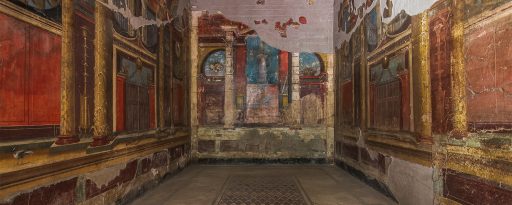
Day 4: It’s to one of the grandest of those villas that we turn next, and to a stunning evocation of all of them. In the morning we visit the Villa Oplontis, palatial in scale, if not town-sized, and possibly the residence of Poppaea Sabina, the ill-fated empress of Nero, about whom so many lurid tales swirl. Whatever the truth of those, and of the connection, this is certainly a place you could imagine an empress living – a vast labyrinth of rooms and limitless corridors, courtyards and colonnades. Everywhere there are the most opulent frescoes, everywhere painted imitations of architecture receding behind the walls, of gods and nymphs, of deftly-painted mortals you could believably place on a street.

There’s simply no way you won’t be awed by the experience. And if you have any amazement left, it’ll be expended in the afternoon. That’s when we visit the museum of Stabiae, housed in a former Bourbon royal residence in a stellar location with views over the Bay of Naples. Within is a collection that has to be seen – book NOW! - to be believed. No words can adequately describe the quality of what’s within and the way it’s brought to you. This is a simply stunning museum where villa frescoes are displayed at their best, in an intimate and overwhelming setting. That would be enough, so we’ll keep it short and just hint at the heart stopping power of the sculpture and the sheer delight of seeing the wedding wagon for the first time. So far this is shaping-up pretty well.
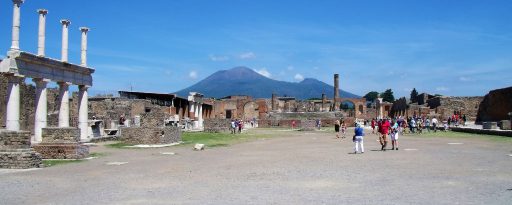
Day 5: We’re finally ready for the grandest site of all ancient archaeology, whose shadow we’ve been in for the whole trip. Pompeii. Few single words in archaeology manage to immediately evoke so much. We’ll spend the entire day seeing that if anything, it was all understatement. We’ll stand in the grand forum, looking down its great axis to that most famous of all the views of Vesuvius, and down streets and alleys where our footfalls on those big, uneven cobbles, and along those flanking sidewalks and cobbles mirror those of the ancient inhabitants far more directly than anywhere else: here, the Roman world is not lost. We’ll pass from pavement through portals into houses each with celebrated names, finds and stories, down the Via dell’Abbondanza and into private gardens and grand public baths. Every day we’ve had so far has been superb and widened our understanding and expectation of what it is possible to see of the Roman world, but Pompeii shows that even that can be topped. Everything is here, from the day that everything stopped.
Day 6: For the rest of the Roman world, time did not cease, and nor had Pompeii been the centre of it. On this day, we take a look at the wider picture of the ancient Bay of Naples by visiting Pozzuoli and Baia. These were ancient Puteoli and Baiae, the centre of the riviera of the Roman aristocracy and the entrepot for the city’s grain and imported trade. It was here that the vast villas of the great names of the Roman world were – Caesar, Cicero, Lucullus and the emperors, here that Caligula built his bridge of boats, and Agrippina met her end in theatrical treachery and here, too, that the vast ships of the grain fleet, the ancient supertankers inbound from Egypt, would be awaited by anxious eyes scanning the horizon. We’ll see the most spellbinding of the sites, with a power to amaze even after what we’ve seen over the last several days, from the colossal amphitheatre of Puteoli and the beautiful harmony of the so-called Macellum to the grandiloquence of the enormous bathing and entertainment complex at Baiae, rising in marvellous tiers up the flank of a sea-facing hill, with enormous halls, domes and palaestras and a truly unique tree, all serving one of the social, political and economic nerve-centres of the continent-spanning empire. We finish the day at our hotel in Naples.
Day 7: A visit to one of the world’s great treasures for our final day, one that triumphantly completes the picture of Pompeii as well as having a wish-list of other first-rank pieces that beats the holdings of some entire countries, never mind mere museums. Our destination is the great Archaeological Museum in Naples. Within, we’ll find the finest and most famous of Pompeii’s frescoes, eliciting multiple gasps in each room as the thrill of recognition hits. There will be masterworks in mosaic, ancient silver, bronzes that will still the power to speak. Everything is a superlative. The statuary, the pinnacle of achievements both from this richest of Roman bays, and from the imperial city itself in the form of the Farnese Collection. What better way to finish a tour than awe-struck?

You’ll have time afterwards to sit spellbound as you take it all in, if you like, to visit more of this vast museum or explore the endlessly busy streets of a remarkable city to bask in more history, or just shop before we have our final meal together.
Day 8: Transfer to Naples Airport.

I would like to book, what else do I need to know?

For information not covered below please refer to our FAQ’s or contact us directly on [email protected]

Arrival and Departure Information 16-23 April 2027

Arrival Airport – Naples (Capodichino)

Departure Airport – Naples (Capodichino)

Check in time at the Habita79 Hotel in Pompeii is after 15:00 so we recommend choosing a flight that arrives mid to late afternoon. Check out time is 11:00 am. We will arrange local transfers from Naples Airport and to Naples Airport on the first and last day of the tour.

Arrival and Departure Information 8-15 October 2027

Arrival Airport – Naples (Capodichino)

Departure Airport – Naples (Capodichino)

Check in time at the Habita79 Hotel in Pompeii is after 15:00 so we recommend choosing a flight that arrives mid to late afternoon. Check out time from The Grand Hotel Santa Lucia in Naples is 11:00 am. We will arrange local transfers from Naples Airport and to Naples Airport on the first and last day of the tour.

Booking Flights
The cheapest way to book flights to Naples is directly with the airline online.

If you prefer to book with a travel agent, we are happy to recommend specialists in a number of countries around the world, please contact our office for more details.

Travel Insurance
We consider adequate travel insurance to be essential. You should ensure that you take out a suitable policy, to make sure that your trip is properly covered. Please be advised some insurers may require you to take out a policy within 15-20 days of booking your holiday to receive all of their insurance benefits.

The European Union’s Entry/Exit System (EES) and the European Travel Information and Authorisation System (ETIAS).

The Entry/Exit System (EES) is a new digital border management system for registering non-EU nationals travelling for a short stay, each time they cross the external borders of 29 European countries using the system. The EES will modernise border management of the Schengen countries, gradually simplify border controls and prevent identity fraud. ETIAS travel authorisation is an entry requirement for non-EU visa-free nationals.

You find out more about EES & ETIAS using the link below

https://travel-europe.europa.eu/pb

Visas
For UK Nationals, You can travel without a visa to the Schengen area, which includes Italy, for up to 90 days in any 180-day period without a visa.

Citizens of European Union or Schengen Treaty member states need no visa for Italy, those from the United States, Canada and Australia do not need to apply for a visa to visit Italy for trips of less than 90 days duration.

Tour Includes:

Accommodation – April – The Habita79 Hotel in Pompeii
Accommodation – October – The Habita79 Hotel in Pompeii and the Grand Hotel Santa Lucia in Naples
All meals (except 1 lunch and 3 dinners) including water, tea and coffee and wine with dinner
The services of your expert tour leaders throughout the entire trip
Airport transfers on first and last day of tour
Travel by private minibus
All entrance fees
All tips to restaurant and hotel staff
Hotel taxes

Not included:

Flights and airport taxes
Visas
Travel insurance
Tips for drivers
Tips for guides

Paul Beston

Inspired by finding a musket-ball in Gibraltar, Paul spent his childhood drawing Spartans, watching historical documentaries and devouring archaeology books. Certain that life ought to revolve around his passion for the ancient world Paul studied Ancient History at King’s College, London, gaining a first, and then earned a distinction in his Masters. Alongside lecturing posts at King’s and Royal Holloway in London, he has acted as an historical adviser for TV including HBO’s Fire from Heaven. Previously he taught Classics in Hertfordshire but we are delighted that he is now full time with us. He is also working with Michael Metcalfe on the publication of some notebooks of early travellers to Greece. He has a lively interest in all periods and regions, but a particular passion for Late Antiquity, Roman Britain and the Near East. He also focuses on tour design, creative content, and writes our blog and newsletters. We are very glad Paul is on our team of guides.

What previous guests have to say about Paul:

"Paul Beston is fantastic. He is hugely knowledgeable and engaging and really brings the history to life. He is the difference-maker!" Rhys Grossman

"Couldn’t have been better. Incredibly knowledgeable, professional, and never off duty. Nothing was too much trouble. This was our second trip with Paul Beston as a guide and he did not disappoint. Rome was brought alive! It was another amazing holiday and we will be back." Jan Rowland

"A wonderful learned host whose comprehensive and lively knowledge was superb. I would give Paul a 12 out of 10 – always engaging, open to questions - I was enthralled and engaged, and appreciated his care for everyone on the trip. An intellectual feast!" Janyce Rebecca Lyman

"Paul is the most excellent guide for all things ancient." Christopher Shore

"Paul made it an outstanding trip. 10 out of 10. If I could rate at a higher level I would. Paul is an excellent leader, source and inspiration." John Persiani

View Paul Beston's Biography

Accreditations

Tour Operator of the Year 2015 Gold Award AITO logo Tour Operator of the Year 2016 Silver Award AITO logo Tour Operator of the Year 2017 Gold Award AITO logo Tour Operator of the Year 2018 Silver Award AITO logo Tour Operator of the Year 2019 Silver Award AITO logo Tour Operator of the year Gold Award 2022 AITO logo Tour Operator of the year Silver Award 2023 AITO logo Tour Operator of the Year Gold Award 2024 AITO Logo Tour Operator of the year Platinum Award 2025 AITO logo British Travel Awards Best Travel Company for Arts and Culture Holidays Silver 2022 logo Peter Sommer Travels is an accredited member of AITO The Specialist Travel Association logo Peter Sommer Travels is a member of ABTA the Association of British Travel Agents logo Peter Sommer Travels is a member of ASTA The American Society of Travel Advisors logo Peter Sommer Travels is a member of ABTOI the Association of British Travel Organisers to Italy logo

Rated as Excellent on Aito Reviews with over 900 reviews