
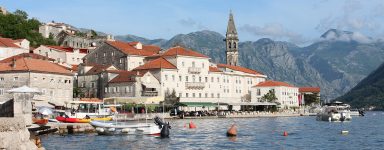
Montenegrin food
Montenegro has a distinctive local food culture which has maintained its imprint. The limited nature of communications in the hills especially and the immediate availability of localised crops has seen an attachment to traditional foodstuffs, some of them regional even within Montenegro, and this has been accentuated in a distinct movement in the country towards sustainable production and organic farming.
This means Montenegro offers fresh, characterful local food, from supermarkets down to roadside sellers and family tavernas (konobas). Montenegrin cuisine reflects the country’s rich history and blends Mediterranean, Central European, and Ottoman influences.
Montenegro’s coastal areas lean toward Mediterranean flavours, with a focus on seafood. At the same time, the northern regions are renowned for hearty meat dishes and dairy products, reflecting the agricultural practices and colder mountain climate.
Traditionally, fish was considered food for the lower classes and seldom appeared on the tables of noble families in coastal cities like Kotor and Budva. Today, however, seafood takes centre stage in Montenegrin cuisine. Specialities such as grilled fish, calamari, and octopus are staples at nearly every coastal restaurant. Popular fish varieties include tuna, dentex, scorpion fish, and gilt-head bream.
Simplicity defines the preparation of coastal dishes. Grilled fish, dressed with olive oil, parsley, garlic, and a pinch of salt, is the perfect example of Montenegrin coastal cuisine. Cephalopods like squid, octopus, and shellfish are also central to the region’s gastronomy.
A standout coastal dish is buzara, a seafood stew with Venetian roots. It is typically made with prawns or shellfish and features a rich base of wine, garlic, and tomatoes. This dish traces its origins to the Venetian lagoon, where fishermen cooked quick meals in an iron cauldron called a buzara.
The Ottoman Empire’s influence is most pronounced in Montenegrin meat dishes. Grilled staples like ćevapi and pljeskavica are ubiquitous across the Balkans, reflecting Ottoman culinary traditions. Dishes like burek (flaky pastry filled with meat or cheese) and sarma (cabbage rolls stuffed with minced meat and rice) have been adapted over time, becoming integral to Montenegrin cuisine. Another hallmark of Ottoman influence is rakija, a traditional fruit brandy often served as a welcome drink or aperitif.
In the mountainous regions of Montenegro, hearty, warming dishes take centre stage in the local cuisine. Notable examples include Kačamak, a robust cornmeal and potatoes dish enriched with local cheeses and often served with sour milk or yoghurt. Another favourite is Brav u Mlijeku, lamb slow-cooked in milk until beautifully tender with vegetables and herbs, resulting in a rich and flavorful broth.
One of the oldest surviving cooking techniques in the Balkans is preparing food “ispod sača,” which translates to “under the bell.” This method involves slow-cooking meat and vegetables beneath a cast-iron or ceramic lid with hot coals. The process varies in name and can be found from the eastern Adriatic coast to the heartland of the Balkans. Evidence of this cooking method dates back to the Late Bronze Age in the region, approximately 3,200 years ago. Originally a rural tradition, it has now evolved into a hallmark of fine dining, with dishes like sač-roasted octopus offering a delightful experience for seafood lovers.
Montenegrin cuisine is deeply rooted in local ingredients. The mountain pastures yield a variety of cheeses made from cow and goat milk, which range from firm and salty to soft and mild. A local delicacy is Njeguški pršut, a dry-cured ham from the mountain village of Njeguši. This ham is cured with sea salt and dried by the bura wind, typically served with cheese and local olives.
Skadar Lake also contributes to Montenegrin cuisine, providing delicacies like carp in various traditional styles. At the same time, seafood arrives straight from the Adriatic right to the table.
Montenegro’s olive oil, pressed from centuries-old groves, is gaining recognition in European markets. This demonstrates the country’s commitment to preserving and promoting its culinary heritage.
Discover Montenegro on our expert-led tours
A multi-award-winning family-run travel company, Peter Sommer Travels offer expert-led tours for small groups. In spring 2023, 2018 and 2016 we received the UK’s Tour Operator of the Year Gold Award and in spring 2024, 2020, 2019 and 2017 the Silver Award from AITO, the UK’s most prestigious and leading organisation for specialist tour operators.
If you would like to know more about any of our Montenegro gulet cruises, please get in touch. We will be delighted to help.

Average rating 5 out of 5 from over 950 reviews for Montenegrin food, according to AITO reviews.


