
The History of Montenegro
The history of Montenegro, a small country, has primarily been influenced by the actions of major European powers in the Balkans. This history began with the Roman conquest and continued through the Middle Ages under the Byzantine Empire, followed by the Venetian Republic and the Ottoman Empire. In the 19th century, Montenegro witnessed conflicts involving Austria, France, and Russia during the Napoleonic Wars. However, it wasn’t only these conflicts that shaped Montenegro into the nation it is today; there was also a long-standing coexistence along the borders of these mighty empires throughout history. This interplay of conflict and coexistence ultimately shaped the modern Montenegrin identity.
Montenegro: A not-so-brief timeline
Circa 180,000 BC: Neanderthal hunters use Crvena Stijena as a camp.
Circa 6000 BC: The first farmers reached the shores of what is today Montenegro, introducing farming, pottery and domestication of animals to the eastern Adriatic. Before this, the region’s inhabitants relied on hunting and gathering for sustenance.
229–169 BC: The Illyrian Wars, which included three distinct campaigns, targeted various Illyrian tribes and alliances along the eastern Adriatic coast. Rome achieved total victory by establishing the Roman province of Illyricum.
Circa 100 AD: Doclea (near present-day Podgorica), initially established by the Illyrians, became a significant city under Roman rule, home to up to 10,000 inhabitants.
Circa 650 AD: Slavic tribes settled in the region of present-day Montenegro.
9th Century – The first vassal state in the area of Doclea (later known as Duklja in Montenegrin and Zeta) is established. Under Prince Vladimir (c. 970–1016), Duklja came under the rule of the Macedonian Emperor Samuel and later Byzantium.
1031 – Prince Vojislav liberates Zeta (formerly known as Duklja) from Byzantine rule.
1189 – Serbian Grand Prince Stefan Nemanja conquered Zeta, which remained under Serbian rule for over 150 years.
1361 – Zeta regains independence under the Balšić noble family, who gradually expand their power.
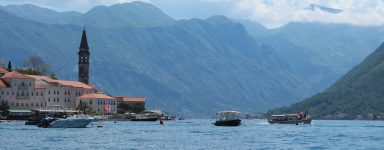
1420 – Kotor and its surrounding area fall under Venetian rule. Venetian influence extended along the coast in the coming decades.
1479 – Skadar and Žabljak fall to the Ottomans. Two great powers of the Mediterranean, the Venetian Republic and the Ottoman Empire, now share a border in what is to become modern Montenegro alongside the small autonomous Montenegrin clans and nobles.
1697 — Vladika (prince-bishop) Danilo establishes the Petrović dynasty. He mediates disputes between clans and begins resisting Ottoman incursions.
1784 — Petar I Petrović is consecrated as Vladika (prince-bishop), becoming a celebrated military and spiritual leader. In 1796, he defeated the Ottomans, significantly expanding Montenegrin territory.
1797 — Napoleon dissolves the Venetian Republic. France and Austria fought for dominance in the Bay of Kotor. After Napoleon’s defeat, however, in 1815, the Congress of Vienna placed Kotor Bay under Austrian rule as part of the Kingdom of Dalmatia.
1910 – Montenegro proclaimed itself as a kingdom, distancing it from Serbia, Russia, and Austria-Hungary while fostering closer ties with Italy.
1916—During World War I, Austro-Hungarian forces occupied Montenegro, forcing King Nikola and most of the government to flee to Italy.
1918 – The Podgorica Assembly on November 26 deposes the Petrović-Njegoš dynasty and declares the unification of Montenegro with Serbia, forming part of the Kingdom of Serbs, Croats, and Slovenes.
1941—Under Italian protection, Montenegrin federalists prepared to establish an independent state. On July 12, 1941, the Montenegrin Assembly declared Montenegro’s independence as an Italian protectorate.
1943—Tito’s communist Partisans achieve military victories, reclaiming territory from the Italians and eventually establishing control over the entire territory of Yugoslavia.
1945—The Federal People’s Republic of Yugoslavia was founded. Montenegro was one of six federal states within Yugoslavia.
1991 – As Yugoslavia began to dissolve, Montenegro remained in a union with Serbia (still called Yugoslavia).
2003 – The state union of Serbia and Montenegro replaces Yugoslavia.
2006 — Following a referendum on May 21, Montenegro declared independence on June 3, with 55% of voters in favour.
Discover Montenegro on our expert-led tours
A multi-award-winning family-run travel company, Peter Sommer Travels offer expert-led tours for small groups. In spring 2023, 2018 and 2016 we received the UK’s Tour Operator of the Year Gold Award and in spring 2024, 2020, 2019 and 2017 the Silver Award from AITO, the UK’s most prestigious and leading organisation for specialist tour operators.
If you would like to know more about any of our Montenegro gulet cruises, please get in touch. We will be delighted to help.

Average rating 5 out of 5 from over 950 reviews for The History of Montenegro, according to AITO reviews.


